Friday, 21 July 2023

Interview with a former GCI/WPN controller in the French Air Force

A former GCI/WPN controller in the French Air Air Force kindly accepted an interview for the blog. T served in ground control centers as well as the E-3F during the Cold War and

Hello T., many thanks for accepting an interview for alejandro-8.blogspot.com. Could you provide us an overview of your career in the French Air Force?

Hello Alejandro thanks a lot for your interest. My name is T. and were in service in the French Air force (FAF) for 30 years as GCI/WPNs (Ground Control Intercept/Weapon Officer). That means I were in military control center, tactical center and for sometimes in E-3F. From 1994 to 2000 I was instructor in formation center at Mont de Marsan AFB, specialist in air materiel, weapons systems and electronic warfare.  After 2000 I joigned Tours AFB as GCI Leader in operational sqn, and at least chief of the standardization cell, in charge of instruction and formation of the center. I had the ability to agree professional licenses for example Air Police on helicos (I spent few month in Guyana for that!!).  As GCI I had medical aptitude to fly on every french aircraft and specially two seat fighters. It’s so that I have a lot of hours on Ajet, MirF1B and 2000B. Same for transport and helicos. The only one I never fly in was the Jaguar E, with regrets.

Can you provide an example of what your role as GCI/WPN consists of?

To have a good response it’s first important to explain the controllers history according the aircraft history in the French air force.  I enter in service in 1979 with Mirage IIIE and Mirage F1C. At this time we had to provide close control, that means to guide the fighter on target. It was logical according the fighter radar which could only do this type of pursuit. In 1984 the air force received the first Mirage 2000 and for us it was a big step, but in the same control procedure. The difference was in the range of detection and so different tactics. 4 years after a new version adapted for low level tracking entered in service, offering new capabilities. I spent my master controller licence with this type of aircraft : Mirage 2000 RDI. Affected to Nice Ctl Station I had the opportunity to participate at a meeting with some 5th sqn’s pilotes of Orange AFB to define the basic communications standard using the RDI. Few years after we had to participate at the 1st Gulf War, our RDI engaged with coalition on AlAhsa AFB. I think it was the big turn to our speciality as GCI. Because we had to apply NATO procedures in a real war environment. After that all became different. And the last thing which definitely changed our control method was the last update of our Mirage, the -5. In French air force pilot-controller is a real duo, because we are the 360° around surveillance operator for the pilot. The GCI is dedicated to the threat alert outside the fighter radar envelope. Today nations using GCI consider the same thing, it’s so that we can provide situation awareness for all and participating for us at big NATO exercises is the best thing to accurate our methods.

We have to consider today loose ctle for main big missions, broadcast ctl in specific environment (low level for example or jamming environment) and at least close ctl for police mission.    

When you are guiding a fighter in an operation, how much autonomy does the pilot have over the GCI? This was a widely discussed topic during the Cold War.

The pilot is under GCI even during the planified slot or until short fuel for recovery or no weapons. The difficulties today are in the coordinations with all the assets and specialy when you have two ctl agencies working in the same airspace, for example an E3 and a ground center. It’s so that the comms must be clear and precise between the GCI sqn leader and the FA (Fighter allocator) in E3 (or E2). For heavy exercises we have to planify specific crews for recovery to shed the GCI. It’s so that for a big one (Tigermeet for example) you have to consider the control center is in maximum configuration.

When detecting a fighter, was there much difference in the distance at which non stealthy fighters were detected (MiG-21/F-16/F-15/Mirage 2000 -some are supposed to have lower RCS than others-) by E-3F?

No there is not a big difference, because you track a signal according pulse doppler effect. But the plane is not important, what you detect in fact is the radar system or electronic system of the plane (same for ground or naval systems). It’s so that you have a EO on board (Electronic Operator). It was a little bit difficult when you have a classical plane without electronic. The case of Air Policing missions is a good example and the difficulty to track a Cessna or Robin !!! But we did.

What was the longest mission you carried out in an E-3F? What do you think is the limit for a crew?

For me the longest were during ex-Yougoslavia conflict. I had the chance to participate at some flights. France often had holding pattern over hungaria, as US were over Adriatic see. For us it was very long and hard for personal on board. You had to be at the AFB 3 hours before for brief and prepare mission, after that take off and direct flight to hungaria. Then holding and mission and at last recovery and debrief. So in resume for a 12 hours slot, you did 15 hours in flight plus 5 hours on the ground. So you can easily imagine for a night flight. And why 12 hours, because you had 2 E3 for 24 hours and take over on holding. For all, the most difficult were night flights because the day before you had to sleep, and for some an helping with sleeping pills. And when you did flights and flights, it was hard. A bad souvenir this conflict for mission and for health.

When operating QRA (Quick Reaction Alerts) how fast could the fighters take off? Is there any difference between the different types (F1/2000/Rafale)?

In France it’s a question of time. Peace alert is in 7 or 15 minutes. And in case of you can request 2 minutes, that means aircraft is on runway ready to take off, pilot inside. You can also use a classic flight (performing training, navigation, refuelling) for a police mission, in condition the pilot has aptitude for QRA. But in this case the aircraft is not armed. Very useful for recognition mission only or a little assistance, the QRA staying home.


In France the QRA is also dedicated to real assistance. All changed after the twin towers disaster in 2011. We had to modify the missions, and train pilots to perform assistance on big civilian airports. It’s so that we did a lot of recovery on Roissy or Orly for example. We also did a lot of escort on US or Canadian flights just after take off from these airports. Today French squadrons continue this type of exercise.    

Can you comment on the deployment of link systems like Link-16? How did they improve mission efficiency/situational awareness?

In early 90’s France has developed a specific link called “teleaffichage” and dedicated to M2000. This link was only used by GCI to give orders or informations to aircraft without radio. In the same time France received first E3F and link 16. Our link was inadapted and not useful, it’s so that we stopped it. With E3F arrival our surveillance operators had to learn and adapt their job at this new environment. Our technicians spent lot of hours to integrate this link in our data environment, but they did. And to update our method to work (specially SO) because they didn’t work in a E3.

The link 16 was important so for them wich had to identify all aircrafts in national airspace and during exercise to establish the good identity. Before to leave Air Force the 1st CAOC was in service with all datas and all links integrated. It was very interesting to have a good vision of the airspace over Lybia during Harmattan MSN, E3F rotating near Sardinia. And for another example during Tigermeet at Landivisiau NAS in 2008, it was important to have a long range alert. At least a specific phase was the recovery because E3F was not allowed for handover patrol to approach, and so, necessary for us to identify the good patrol for the recovery, thank you the link 16.

Can you comment on the improvement of electronics during all this time in terms of weight/reliability? E-2C old computer in the Forward Equipment Compartment weighed 3,000 lb and had 64K of internal memory!


I cannot really answer this one because if I did some flights I made a lot of exchanges in simulator to train the inboard controllers according NATO rules. The work in E2 is really different from a E3 because the operator has to manage the situation but all about, in, out, recovery, handovers. It’s so that he is called “radar operator”. Today you have an E3 controller in exchange with E2 squadron. Same with navy on carrier Charles de Gaulle.
 
Is there an anecdote you would like to share before we finish the interview?

I remember the old exercises where we had possibility to fly supersonic and of course the results on public infrastructures, some anecdotes over Tchad or Gulf but the most incredible for me was the police mission on 2007 june 21st during Salon du Bourget.

For this meeting a crisis cell is activated and in 2007 our CRC (Tours) was leader (logical because in our geographic area of responsibility). I was GCI Leader with 6 crews performing surveillance and control because we had activated axis with helos or slow moving plane to intercept slow traffic. I also had E3 rotating and so linked with it (Fighter Allocator) to coordinate operations. And the show was going well. Until the end of morning where Belgian Control phone me to advise a slow moving aircraft, civilian, coming from Hamburg were flying over Belgian airspace without control inbound France. It was intercepted by F16 and didn’t answer to them. Well note.

Few minutes later Reims approach called me “can you see north my position, squaking XX, these are f16 in my area and the slow mover is unknown, F16 go back home and return to Florennes”. I advise my squadron cmder and decide to scramble te QRA. Few minutes and the M2000 take off from Creil direct to intercept the Turbomooney, with 2 persons on board. The Mirage is on left and the two passengers are happy to see a military aircraft, performing visual signals but occupied to continue their travel to La Rochelle. They don’t listen the frequencies, don’t answer, nothing, they fly.

But they fly directly to Le Bourget where a show is in progress, and of course a complex area in place with SAM for example. I decide to engage a patrol of Tucano performing north axis. We proceed and the Tucano join the couple of aged persons always enjoying the visits of military aircrafts. The pilot in rear back seat has instruction panels, show them, but nothing. We are entering Le Bourget area and according the track they are going for the pleasure of public to overflight the show. And they do it. I had time before by phone to stop the show for safety. What is the next ?

The Tucano call me short of fuel, and Mirage 2000C too because hard to maintain a low speed. I decide to call Tours App for request : “hello, are you waiting for a patrol of Alphajet going for training on axis ?” “yes in 5 minutes” “Ok ask leader if he has agreement for air policing” and the response arrive “yes”. Few minutes later the leader contact us to proceed on the tourists. We intercept them and try to give order to follow the alphajet. For that I decide to use the emergency frq 121.5, I hope he was listening. Nothing. And suddenly a miracle coming from the sky.
 
A Lufthansa pilot who was listening the frq understand what happened and decide to make relay on the frq. I give it instructions in English and the pilot relay in german to the tourist pilot, which understand 2 hours and half after. The little german aircraft decide to follow the alphajet and to land at Tours AFB where french Gendarmerie were waiting for them. The two old persons have been arrested and interrogated for: crossing 2 countries border without radio, overflying restricted areas, non cooperation according police measures. What I know, the day after these tourists were free, the aircraft was requisitioned, the pilot driving licence sent to german ambassy. The pilot has been sentenced in Germany his pilot licence deleted.
After that we make a big return of experience to modify our procedures. And one thing is sure, after that I did a big lunch.

For the story :

https://www.rtl.be/art/info/monde/europe/un-avion-de-tourisme-allemand-intercepte-par-un-mirage-se-pose-a-tours-7417.aspx

Other interviews:

I am always looking for more veterans, active members or people related with the defence industry to accept interviews. If you enjoyed reading the material and would be happy to accept an anonimous interview you can get in contact with me. My e-mail can be found in this link at the heading. Otherwise leave a message in the comment sections.

- Interview with a Chieftain veteran
- Interview with a former Leopard 2A4 gunner in the German Army
- Interview with 2 Romanian MiG-23 pilots
- Interview with a former M48 commander in the National Guard of the US
- Interview with a former M-84 commander
- Interview with a former Merkava tanker
- Interview with a former Abrams tanker
- Interview with a former M60A2 "Starship" tanker
- Interview with a former Centurion tanker in the Army of Australia
- Interview with a former Type-59 tanker in the Army of Albania
- Interview with a former Leopard 2 tanker in the Army of the Netherlands
- Interview with a former Romanian MiG-29 pilot
- Interview with a former M60 tanker
- Interview with a former Pakistani Army Type-59 tanker
- Interview with a former Leopard 1 tank commander in the Army of Canada
- Interview with a former Merkava tanker
- Interview with a former M60A1 tanker
- Interview with a former M60/Abrams tanker
- Interview with a former Olifant tanker
- Interview with a former Challenger tanker
- Interview with a former M551 Sheridan driver
- Interview with a former Centurion tank driver in the Army of Sweden
- Interview with a former Centurion tanker in the Army of Denmark
- Interview with a USAF pilot who flew the F-106 Delta Dart
- Interview with an US Army M48A5/M60A1 veteran tanker
- Interview with a former British artilleryman and veteran of the Gulf War
- Former M60 tanker in the Army of Austria
- Former Chieftain crew member
- Former Chieftain gunner
- AMX30 commander of the Army of France
- NCO of the Army of Serbia 
- Former crew member of Challenger 2
- Former Leclerc commander
- T-72 driver in Czech Army  
- US Army M60 tank crewmman
- Interview with D., former US Army tanker with experience in the M60 and M1 Abrams
- Interview with Stefan Kotsch, former NVA/Bundeswehr tanker  
- Interview with former Marine and writer Kenneth Estes

Friday, 5 May 2023

Interview with a Chieftain veteran

A former Chieftain crewman has accepted an interview for the blog. J. served in Chieftain, Challenger, and Challenger 2, and last year he acceped an interview on his Challenger experience (link). So far he is the only veteran tanker I have talked to that he used the multifuel capacity of a tank engine.

2. What do you think were the strong and weak points of the Chieftain tanks?


Firstly, I have to admit that I started my career in 1987 for the 16/5th The Queens Royal Lancers, a reconnaissance regiment with CVR (T). I trained on chieftain along side the Chally 1 before our amalgamation with the MBT regiment the 17/21st Lancers. Our new regiment was equipped with Chally 1.

I first saw, (and heard) a Chieftain in January 1987 in Catterick (where all recruit gunnery training was being carried out at the time). One can never forget that distinctive tubular roar as they headed off the tank park in the rain and off into the misty Yorkshire dales to scare the sheep. On their return, the drivers (who had to drive ‘opened up’), always emerged from the cab, faces wrapped in goggles and ‘headover’ scarf, steaming damp from the ample rainwater that poured on them from the turret sill every time they braked! Protected by army waterproof overalls, affectional known as a ‘crisp packet’.
The tanks strong points were its accuracy, and being able to get rounds off accurately even if every system in the turret had failed.

It's weak points (according to seasoned drivers) were having to change the clutch springs, and its ability to drop it’s oil and stop at the most inopportune moments! Something that struck fear in any commander taking part in televised VIP parades!

In hot weather the turret batteries behind the operator in the bustle used to get hot and occasionally gas off. To cool them down you could wedge open the battery hatches on the turret roof. The operator/ Loader could then see daylight from his position via the hatches.  The trouble is, you didn’t want to do this on a live range with infantry behind you! Oh how they loved sneakily shooting the tanks on an assault! Because of this, we never put anything nice in the thin side bins like sleeping bags and weapons!

3. When training, what was the typical distance to the objective and speed of the tank when you fired? And the longest distance at which you ever fired?

Much the same as the Chally 1, (after all, it was pretty much a chieftain in new clothes).

We generally trained from emergency short range targets at about 600m, firing on the move at 1000m to 1800-200m. Occasionally we would do long range shoots using the Quadrant Fire Control (QFC) at around 5km+. You could throw them further but ranges were hard to find and the commander, or someone, had to physically see the target impact and make corrections. This awesome simple bit of kit attached to the gun next to the gunner (which consisted of two rotating drums/ wheels representing the angle of sight, the range to target and a bubble level), was worth its weight in gold, but sadly not included in the Chally 2. It’s still in use on the Scorpion 90’s in Indonesia as I witnessed in 2021.

4. Chieftain tanks use a human autoloader and 3 piece ammunition. What was the maximum rate of fire you achieved? How did it change as you used the different ammunition bins?

As has probably been mentioned before, officially it was 6-8 seconds but a well prepared loader could get an average of 4 seconds for at least 6 to 8 rounds. After that, retrieving rounds (as the gunner laid onto target) became slower as the 6 round ready tray was empty and other rounds and charges were in ‘slower’ locations. It was actually an incorrect drill to pull the loaders safety shield closed (that completes the firing circuit) before retrieving his next round, however it speeded things up to get the round AFTER the shield as long as you didn’t go behind the gun while doing so.

5. What was the typical ammunition configuration load (% APDS/HESH/Smoke)?

This depended on the mission and the type of tank you were in, command tanks typically had less ammo to naturally accommodate extra radio equipment in the turret bustle.

A troop would be issued some measure of smoke which was given or spread to vehicles relevant to a task on a mission. If you were expected to face heavy armour then we would be heavy on the APFSDS. During my last operation we were actually carrying blue SH/P (a practice round full of concrete). This was used to good effect in urban areas for specific targets causing minimal collateral damage.

6. In terms of maintenance, was there any component or system that was more delicate? Were there any issues with the supply chain?

I can’t recall anything being really delicate on the Chieftain, it was pretty robust and “soldier proof”. If anything broke on the move, there wasn’t much that couldn’t be fixed with gaffer tape and green string until you got attended too by the REME following close behind.

7. What was the maximum distance you covered in a day during deployments or exercises? Did the tank cope well or needed extra maintenance?

Some would say, not far as it regularly broke down! To be fair, a good attentive, well-trained crew would do well. It’s for this reason a regiments reputation was always on the line when performing on ranges and exercises. Stories, scores, and rumours flew around the higher echelons of the Royal Armoured Corps and filter down to the lower ranks, resulting in much toilet wall humour wherever we congregated!  

8. The Leyland L60 engine was an issue in early Chieftain models. Were the problems solved in the variants you used?

I personally have no real experience with the ‘bottom half’ of the Chieftain as I converted on my drivers course on a Challenger 1.

9. One of the theoretical advantages of the Leyland L60 was that it was multifuel. Did you ever use this feature in training or manoeuvres? Is there any procedure that needs to be followed if different fuels are used (clean filters, purge components)?

In the Balkans, (on Chally 1, a different engine, I know) the temperature in the mountains got down to -24. The squadron of tanks were stored in a huge barely heated tent. We had to start the engines every 4 hours in a failed attempt to stop the diesel turning to sloppy paste. In the end we drained the fuel bags and filled up with aviation fuel delivered from a nearby RAF fuel dump. Eventually, with the GUE (Generator Engine) running, we got them started without any mechanical wizardry.

10. Chieftain used a Horstmann suspension, while other tanks of its era used torsion bars. What is your opinion on its advantages and disadvantages?


Sorry, I wouldn’t know, (me being a turret monster! However, I’ve helped change a few CVR(T) torsion bars and it was a bit of a lengthy task, also the bars have to go through the hull interior where the turret cage sits, so this loss of space has to be accounted for in the design.

11. What was the maximum speed you managed to get in a Chieftain? And in reverse?

It was quite slow when compared to modern tanks, around 20-25mph/ 32Kmh cross country and a little faster on the roads. In reverse, you never wanted to go too fast, unless you were sure your driver knew 100% his left from his right!

12. Did you practise NBC situations? What was the approach? How did it affect the crew performance (especially loader)?

We practiced NBC conditions quite often on exercise, and a lot during Desert Storm on Chally 1!

Comms were sometimes an issue when trying to understand the warblings of radio operators talking through a respirator microphone! Both Chieftain and Chally 1 were issued a large hand held microphone (like the sort sports commentators used) it had similar 1920’s sound quality and was never used. But during regular tool and equipment checks on the tank park, (where all equipment is laid out and accounted for), when this item was called out, the man closest would always pick it up, put it to his mouth and in his best Richard Burton voice shout “Broadsword Calling Danny Boy!”

The operator had the best time of it closed down in the turret, with room to stamp about, sit or slouch. The rest of the crew were pretty much stuck in their seats. The commander got to elevate the gun and stretch his legs over the breech ring. Gunners stamped their feet and drivers slept.

There was a time in Canada in 1996, during the Mad Cows paranoia when all troops (eating beef product rations) were forced to crap into double lined mylar bags and save them on the vehicle, (so as not to contaminate the prairie) then hand them over to an unimpressed soldier at Replens who suffered much jibing and mickey taking! The art of rotating through to the operator’s side and depressing the gun for privacy to take a dump was good practice for NBC conditions!

Despite being in mylar bags, there was a definite aroma emanating from the external bin where they were eventually stored!

13. Some Chieftain tanks were deployed in Berlin. Did you consider urban scenarios in your training?

Yes, but not predominantly. We all had our pre-planned fighting positions to engage the masses of the Soviet vanguards in surrounding fields and forests, that offered a modicum of manoeuvrability, and as far away as possible from any major enemy urban strikes.

They were called our “crash out” positions, or in Reconnaissance, jokingly known as our “grave positions” with a life expectancy of 20 minutes!

Urban expertise came much later by necessity, from a new generation of troops, in the busy streets of Basra and Al Amarah.

14. Chieftain was operated by other countries (Oman, Kuwait, Iran). Did you get any feedback from their use or reports from combat experiences?

I knew a ‘Kings Own Hussar’ who served under the Sultan of Oman. He had nothing but good things to say about his time there.

I found that when oil rich countries bought our tanks, they always got nice upgrades like a .50 Cal pintle mount that the MOD wouldn’t consider.

15. Vickers developed more advanced variants of Chieftain that were never bought by the British Army (Khalid). Did you have a chance to familiarise yourself with them?

No, unfortunately not, I just read journals of the time. I am now lucky enough to be in a job that tests and sells to such countries, so I still get to play with the latest ‘big boys toys’ at 55 yrs!

16. Do you think Chieftain could have been developed more or it was better to move into the Challenger series?

I believe it served well for its era. The Chally 2 was a massive leap in the right direction. But we all live in hope that BAE and Rheinmetall don’t bleed the taxpayer dry with the upgrades.

Other interviews:

I am always looking for more veterans, active members or people related with the defence industry to accept interviews. If you enjoyed reading the material and would be happy to accept an anonimous interview you can get in contact with me. My e-mail can be found in this link at the heading. Otherwise leave a message in the comment sections.

- Interview with a former Leopard 2A4 gunner in the German Army
- Interview with 2 Romanian MiG-23 pilots
- Interview with a former M48 commander in the National Guard of the US
- Interview with a former M-84 commander
- Interview with a former Merkava tanker
- Interview with a former Abrams tanker
- Interview with a former M60A2 "Starship" tanker
- Interview with a former Centurion tanker in the Army of Australia
- Interview with a former Type-59 tanker in the Army of Albania
- Interview with a former Leopard 2 tanker in the Army of the Netherlands
- Interview with a former Romanian MiG-29 pilot
- Interview with a former M60 tanker
- Interview with a former Pakistani Army Type-59 tanker
- Interview with a former Leopard 1 tank commander in the Army of Canada
- Interview with a former Merkava tanker
- Interview with a former M60A1 tanker
- Interview with a former M60/Abrams tanker
- Interview with a former Olifant tanker
- Interview with a former Challenger tanker
- Interview with a former M551 Sheridan driver
- Interview with a former Centurion tank driver in the Army of Sweden
- Interview with a former Centurion tanker in the Army of Denmark
- Interview with a USAF pilot who flew the F-106 Delta Dart
- Interview with an US Army M48A5/M60A1 veteran tanker
- Interview with a former British artilleryman and veteran of the Gulf War
- Former M60 tanker in the Army of Austria
- Former Chieftain crew member
- Former Chieftain gunner
- AMX30 commander of the Army of France
- NCO of the Army of Serbia 
- Former crew member of Challenger 2
- Former Leclerc commander
- T-72 driver in Czech Army  
- US Army M60 tank crewmman
- Interview with D., former US Army tanker with experience in the M60 and M1 Abrams
- Interview with Stefan Kotsch, former NVA/Bundeswehr tanker  
- Interview with former Marine and writer Kenneth Estes

Sunday, 19 March 2023

Interview with a former Leopard 2A4 gunner in the German Army

A former Leopard 2 accepted an interview for the blog. M. served in a Leopard 2A4 in the mid-late 80s as a gunner,

Hello M., many thanks for accepting an interview for alejandro-8.blogspot.com. Could you provide us an overview of your career in the Bundeswehr?


In the 80`s everyone has to attend to go to the Army, or THW (civilian Technical Support Service or doing service in a social unit as a helper). Because I first was interested in an Army carreer, I enlisted myself. After been there a while, I withdraw my plans, because there wasn`t enough posts, to get really in an officers career. So ended up as a regular “Obergefreiter” which is some kind of PFC (private first class).  I was a loader on a Leopard II A 4 in a company  in a bataillon of “Panzergrendiere” (Infantry). The regular time was than in those days 15 months of duty.  

What do you think were the strong and weak points of the Leopard 2A4?

Weak: As always the top especially the openings for the air intake system.
Strong: Easily with a trained crew most efficiently in reckoning and destroying enemy vehicles. The different features were very helpful, the ammo (2 kinds of ammo for armoured and unarmored vehicles), and of coursed the 120mm smooth canon of “Rheinmetall”. Also two MG 3, a newer version of the old MG-43 which was used by the Wehrmacht, was helpful to protect the tank against enemy infantry.                                                                          

When training, at was the typical distance to the objective and speed of the tank when you fired? And the longest distance at which your tank ever fired?

The usually capacity was 2.000 meters, but it was also possible to get a full hit at 4.000 meters. The A4 got a special feature, called “Waffennachführanlage” (weapon tracking system) which enables the canon at ANY speed to point on the choosen target. When it was in “bad position” it wasn`t possible to shoot, only when the optic instruments were again on the target, it was possible to shoot. It was very precise!

What was the typical ammunition configuration (% APFSDS and HEAT)?

2 type of ammunition.
KE – Kinetische Energie (kinetic energy) = for armored targets. A 50cm large arrow made of Wolfram (Tungsten) which was able to penetrate very thick armor.
MZ – Mehrzweck  (Multipurpose) = for unarmored targets /lorries, buildings...) filled with explosives in a highly military quality
In terms of maintenance, was there any component or system that was more delicate? Were there any issues with the supply chain?
We have to take much care of the optic system, which has a very specific cleaning process. The canon has once in awhile to cleaned inside and of course the hydrometers, when they changed their color from blue in slight purple, we had to change them, so the instruments were not to get soaked in water. Also the chains took some hard work to change its rubber patches – which allows the tank to get much more speed on regular streets.

What was the component that required more maintenance/attention?

Changing the rubber patches was much work. First we had to lose the tracks from the tank, so it lays down flat on the ground. Then every single rubber path was to dismantle with a large hammer and special chisel, to get off the track. And then again with a large hammers pushing the new rubber patch in its new place. It took 16 soldiers with long crowbars to turn the tracks upside down so the work could be done. That usually took many hours.     

What was the maximum distance you covered in a day during deployments or exercises? Did the tank cope well or needed extra maintenance?


When “training in field” it was limited to 72 hours in a single shift. It was said, that just one minute later, that was a clear sign that NATO was in a war. So there was a limit to the hours of one shift. My longest shift was in a practice area in Bergen-Hohne and it lasted 58 hours. Driving, guarding, fighting and patrolling.

Did you practise NBC situations? What was the approach/procedure in these situations? How did the NBC kit affect the rate of fire?

The tank was nearly safe from the threats. Inside the tank was an air overpressure, so biological and chemical materials can´t come inside. We were equipped with Atropine syringe, for self treatment. We had special rubber suits, to detect outside the tank ABC (Atomic, biological, chemical) materials. In that situation, we had to put the front of the tank to the main explosion, and after that leave the place. We should have stayed in the tank. Inside the tank work was going on like before, it doesn`t affect much our work while driving, fighting.

Did you have the opportunity to train with other countries (NATO for example)? What was your impression about their training and equipment? Any tank (or other weapon) you liked or disliked?

No. I just heard, that American soldiers were impressed, because we were young, normally 18years old and already had many special skills.

What about the Soviet Army/Warsaw Pact, what was your impression on their tanks? Was there any equipment you particularly liked/disliked?

We had lessons to learn about the “weak parts” of their tanks. It was said, they had much more tanks, but their capacity & quality wasn´t that high, so we had the feeling, we had a superior tank.

Did you receive intelligence on potential threats (T-72, AT missiles, IEDs)? If so, how accurate was it once you got access to the weapon?

No

Were you serving when Germany was reunified? Were there any changes in your day to day routine?

I was on duty July 1986 until October 1987, Germany was reunited in 1989. We had once a guided tour do the area on the german-german border, were we would have fought, “our” battleground when it had come to a war. We were very close to the border and all the markings on the bus, our names and ranks were taped, and we were closely monitored by the guard tower soldiers of the former GDR.

What is your opinion on autoloaders?

We once had a museum tour at the German tank Museum in Munster. We saw a A 70 (German tank in the 1970´s, as far as I can remember that) which had an autoloader. Quite useful on the one hand, but the loader had more to do, so we as loaders were responsible for the coaxial and the turret MG, and some other duties. Our team on the A4 was 4 soldiers. Maybe more space for the soldiers, less to carry with them (clothings, water, food, equipment, barbed wire, wood, camouflage nets...)

Is there an anecdote you would like to share before we finish the interview?

Oh, yes :o)

Once we had a training in Bergen-Hohne, the biggest military training area in Germany. We were on attack with the 1st platoon (4 Leos). In the distance there were wooden targets on wire, which jumped from the ground to show a silhouette of a tank, truck, vehicle. Then we had to shoot in a specific position or at full speed at these targets. And also dozens of single wooden infantry jumped as silhouettes and we had to get them down with our coaxial MG. I forgot to uninstall a steel cap at the top of the gun of the coaxial MG (to avoid that bullets were accidentally fired). Our tank commander taught us, we should fight, as we were in a real tank fight. So I yelled in the communication system: “Coaxial – failure, try to cope with, but now we can`t use it”. So the driver, he was one a of tricky guy – did just that, a “Russenkreisel” a russian turnover, like they did in WWII when they pass the german trenches, and while turning the tanks on the spot they crushed the german hiding in their trenches. Our tank destroyed the whole wire system, the wooden silhouettes, everything. The commander yelled at him, to stop that. Drivers reply: “We are at war, I have to stop them!” :o)    

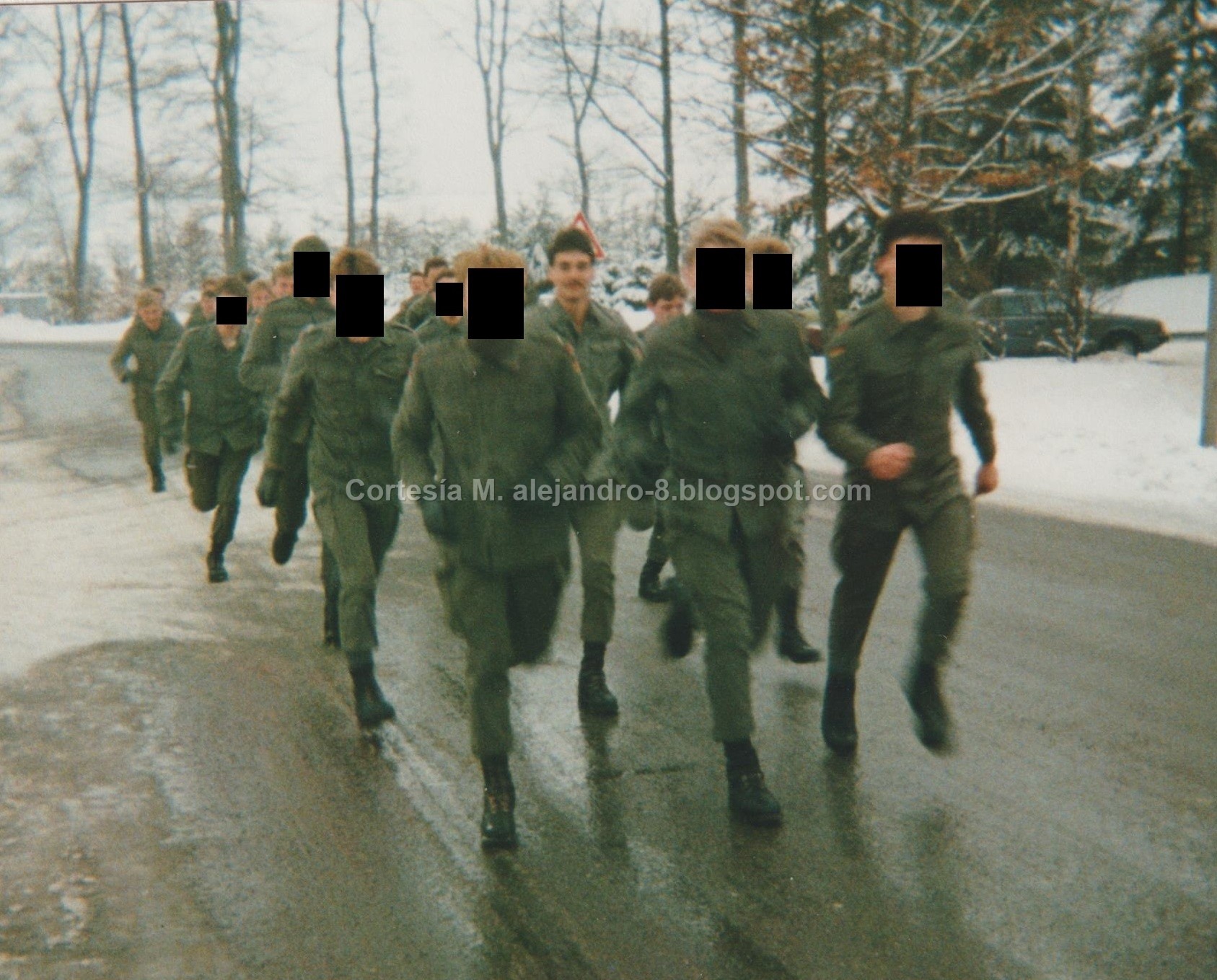
Photos taken by M. during his service in the Bundeswehr


Other interviews:


I am always looking for more veterans, active members or people related with the defence industry to accept interviews. If you enjoyed reading the material and would be happy to accept an anonimous interview you can get in contact with me. My e-mail can be found in this link at the heading. Otherwise leave a message in the comment sections.

- Interview with 2 Romanian MiG-23 pilots
- Interview with a former M48 commander in the National Guard of the US
- Interview with a former M-84 commander
- Interview with a former Merkava tanker
- Interview with a former Abrams tanker
- Interview with a former M60A2 "Starship" tanker
- Interview with a former Centurion tanker in the Army of Australia
- Interview with a former Type-59 tanker in the Army of Albania
- Interview with a former Leopard 2 tanker in the Army of the Netherlands
- Interview with a former Romanian MiG-29 pilot
- Interview with a former M60 tanker
- Interview with a former Pakistani Army Type-59 tanker
- Interview with a former Leopard 1 tank commander in the Army of Canada
- Interview with a former Merkava tanker
- Interview with a former M60A1 tanker
- Interview with a former M60/Abrams tanker
- Interview with a former Olifant tanker
- Interview with a former Chieftain tanker
- Interview with a former M551 Sheridan driver
- Interview with a former Centurion tank driver in the Army of Sweden
- Interview with a former Centurion tanker in the Army of Denmark
- Interview with a USAF pilot who flew the F-106 Delta Dart
- Interview with an US Army M48A5/M60A1 veteran tanker
- Interview with a former British artilleryman and veteran of the Gulf War
- Former M60 tanker in the Army of Austria
- Former Chieftain crew member
- Former Chieftain gunner
- AMX30 commander of the Army of France
- NCO of the Army of Serbia 
- Former crew member of Challenger 2
- Former Leclerc commander
- T-72 driver in Czech Army  
- US Army M60 tank crewmman
- Interview with D., former US Army tanker with experience in the M60 and M1 Abrams
- Interview with Stefan Kotsch, former NVA/Bundeswehr tanker  
- Interview with former Marine and writer Kenneth Estes

Monday, 28 November 2022

Interview with 2 Romanian MiG-23 pilots

Two Romanian MiG-23 pilots kindly accepted an interview for the blog. This country operated 36 MiG-23MF and 8 MiG-23UB until 2001. V. has 100-150 hours on it, and G.I. 810, having served as an instructor before retiring. I would like to thank them for their time and effort.

1. What was your first impression of the MiG-23?  What were the main advantages when compared to previous generation fighters in Romania?

I wasn't very happy in the spring of '86 when I was told I would be moving to the MiG 23...I had just moved on to more serious training and combat duties on the 21st when suddenly my MK promotion (57th Fighter Regiment at that time which was located in Mihail Kogalniceanu hence the initials MK) was moved to the theorethical course and then flying on the 23rd. Up to that time I was not at all impressed with the 23rd in any way. It didn't seem to me that it was superior to the MiG 21 and anyway the opinions about its performance in our world, of aviators, were more negative than positive. In time, during the almost 4 years of flying it, I managed to realize where and what were the advantages and disadvantages of this aircraft.

At first glance the plane was larger and obviously heavier with variable geometry and was the USSR's answer to similar aerodynamic solutions in the West (F-111 and then F-14). At this first assessment I realized that it certainly did not have such a short flight range and that it probably had some other advantages that I will discover when I start flying it.

After starting the flight I realized first of all that the engine automatic (and I mean the elapsed time for the engine to get from Idle to Military and from Idle to Full Afterburner) was much more advanced and the times were extremely low which was very good because these times at 21 were frighteningly high. One interesting thing I discovered after boarding the cockpit was that the Throttle  no longer moved on a circular sector (as on all the planes flown before) but moved linearly and very easily and could be very well controlled.

Later I would also discover that although stable on the slope and at slower speed, the landing itself had to be done carefully because if you made contact with the nose wheel first and then tried to fix it, the landing would turn into a disaster as I found out not from myself or any of my colleagues but from what Russian pilots told us. It was absolutely forbidden to push the stick forward when landing, which if I am not mistaken was also written on a warning plate - obviously in Russian - in the cockpit.

During this interview I will add other things I discovered with the experience of flying it.

2. Visibility is considered one of the weak points. Did you find it to be an issue?

Maybe for those who had not flown the MiG 21 the visibility in the cockpit could be judged as inadequate, but we came from the plane that besides having poor visibility in the cockpit was also coming at 430 km/h on the landing slope, so it was not a problem for us. The MiG 21 was not an easy plane to fly and not very forgiving of the mistakes inherent in beginners. After I started flying it (I'm talking about the 23) it seemed to me that the speed on the slope was low (it was coming at 400 km/h which is not really very small either).

M.K. summer of 1996 - MiG 23 cockpit photo.


But in the course of this interview I will add to the answers some from a colleague – G.I. -a few years older than me who gained more experience on this plane flying it until retirement.

G.I.: Visibility in the cockpit was poor…as was in 21..I was in the cockpit of an F16, with the canopy closed, and there is no comparison... The one-piece canopy is something else....

3. Many Airforces, including the Romanian, found that the MiG-23 was expensive, and carried on using MiG-21s. Do you think that the extra cost and complexity was worth it?

I don't recall these cost issues ever being on anyone's radar, regardless of the level of the tier being considered. It was not at all our job to quantify costs and whether they were high or low...our job was quite different and that was not done according to normal indicators either....

G.I: As far as I know, no country with 23s upgraded them, because, like us, they thought they were efficient, but they were big fuel eaters and not only...

4. How many hours did you fly on the type?


I personally not more than 100-150  hours ...but let's not forget that the time of the transit on this plane corresponds to the moments of sad fame of our nation when the economies imposed by Ceausescu and the communist policy were acutely reflected in the flight hours allocated to pilots of all categories. With it I started night flying and flying in all weather conditions day and night and thanks to the slightly more advanced avionics than the 21 this category of flight could be approached more easily.

G.I.: I flew about 750 hours on the MIG-23 MF, and about 160 on the 23 UB ( the twin seater ) .  I was  flight instructor both day and night in all weather conditions .....

5. What was the maximum range of the radar?

The detection range of the Saphire Multi Mode Radar was no more than 40-45 km from the forward hemisphere for a target with a RCS ( Radar Cross Section) in the range of fighter size aircraft or around 60 km for a target with a RCS  in the range of transport or bomber size aircraft but at altitudes above 9-11,000 metres. But you couldn't lock on  the target for less than 30 km…

What is worth noting as a huge step forward for the offensive sensor on board the MiG23 aircraft compared to aircraft before it is this first multi-mode Doppler radar with look up shoot up/look down shoot down possibilities (ΔH = +6/-4 km) quite rudimentary. This radar allowed the use of BVR R23 R and T missiles in the forward hemisphere and later to the newer R24 R and T variants which we did not have in our inventory.

6. What was the maximum range of the R-24 missiles? Did you use both versions?

We didn't have R-24 missiles, but R-23 with 2 variants R and T.. with IR seeker head or SARH... I  didn't launch any real R-23 missile, because, our bosses said at the time that it was expensive. So I have no idea how an R-23 missile goes.  Those were the days...  But we've all done simulated launches in forward ( and rear ) hemisphere, with school R-23s, at about 10-12 km range......

And in fact, no missiles were ever fired in live firing exercises at the USSR Astrahan range. The missile used for these exercises of real interception of a remote-controlled target was always of the R3S type.  From the memories of my regimental colleague in charge of weapons and firing the only time we used 2 R23 Air-to-Air missiles (in the whole history of the MiG 23) totally unjustifiably was in a mission executed during the revolution of `89 when they were launched in the Boresight in Air-to-Ground mode (!!!) on surface targets somewhere near the Danube Delta and obviously the result did not matter.

The missile theoretically had a kill probability of 0.8 and looked good, but in real combat conditions against a maneuvering target it was limited to a maximum load of 5g and the launching aircraft could not exceed 4g. From the rear hemisphere the maximum and minimum launch distances were more than modest and were, depending on the height, somewhere between 12-14 km and 3-4 km (at medium and low altitudes) respectively 20-25 km and 7-8 km at higher altitudes.

Another important fact proving the poor performance of avionics and weapons computers is the impossibility of using the combined R23R and R23T variant. For silent approach depending on the tactical situation (or what is now called SA) this missile would have been useful but as I showed above its performance was not the most satisfactory...

7. Were you trained to fire one R-24R followed by a R-24T to avoid asymmetrical loads? Or both of the same type?

As I have already shown in the answer to the previous question, a mixed R23 R and R23 T variant could not be made, but only the same type. Asymmetric flight was possible but no one has ever had such a real experience because we have only landed the R23RU school missile and only one on the gloves on the fixed plane of the mobile wing. Even more interesting is the fact that all of us who got to do QRA (Quick Reaction Alert) alarms day or night with this fighter never fired the missiles that were ready on the plane at the alarm room...

8. How far away could you detect targets with the IRST?

With IRST (Infra Red Search and Track) type TP 23 installed on board the aircraft things are a little different. Personally, I have not been able to use it on the few occasions I have had because there is not this sympathy for this kind of use in combat or because over the years of practice those more experienced than us have not used it much to share their experience. In terms of performance, it could detect the target at 5-6 km and the combined weapons system gave a firing solution similar to that of the radar.

I don't know how confident I was in this type of passive sensor but certainly at 23 I didn't consider it a big deal (totally the wrong approach if you think about it !!).

9. What do you think was the best flight envelope for the MiG-23 (altitude and speed)?

I think the altitude range where the 23 was superior to its contemporary aircraft  was somewhere between 2-4000 m and speed between 850 - 950 km/h ( but it's just my opinion and not based on deep experience on this type of aircraft).

MiG-23 pilots.


But it was hard to see that. We were a long way from terms like corner-speed or rate of turn. These terms are built on specific close air combat missions that I never did with the MiG 23. We were using 90-95% of the aircraft on air interception missions based on the fact that it had a much better radar than the 21, being able to engage targets in both the front and rear hemispheres and using its look-up / look-down capability.

10. Do you remember the maximum speed and height you reached with the MiG-23?

Yes I remember this because the Tumansky R29-300 engine was extremely powerful and actually when we launched at full speed and altitude the plane was accelerating slightly towards M=2 and the height was already 17500 m...

G.I.: On an intercept, of a MIG-23 , a colleague on target post, I reached H= 16.5 km... and max speed...I "ran" after a Russian bomber, in the framework of the Warsaw Treaty, with M=2,2, because I was taken far behind him.. MIG-23 had max. permissible ceiling 18,5 km, and max permissible speed M=2,35...

11. When flying, what was the most common position of the variable geometry wings (16, 45, or 72 degrees)? Were there any limitation in G loads or manoeuvres when changing the wing position?

The most common wing position was on 16. All positions were limited by speed and allowable overload....When changing the wing position, the airplane got a bit off balance and you had to trim it all the time.... In the cockpit there was even an indicator with a model of an airplane that changed its wing position according to the one you set manually (with the lever on the left horizontal console next to the flaps buttons) and that had two windows in which the speed and Mach number restrictions for that position were written. It was also suggestive and in the field of view....

12. Did you practice any ground attack mission? What type of armament did you use? How effective was the MiG-23 in this role?

I didn`t use the aircraft in air to ground missions; from the memories of colleague G.I.:  
We executed air-to-ground firing with the on-board 23 mm cannon GS23 and 57 mm PRNDs. They were effective ( in my opinion seeing them go in on target). MIG -23 had the possibility to take also 2 x UB-32 pods, so 64 rockets in one attack... One time I launched 32 rockets in the range and I made havoc.....

The aircraft also had an H-23 Air to Ground missile that could be taken for this type of mission and had on the left glove  a DELTA gondola that was used for guidance. This missile I don't recall ever being used for range training but only as a test...Anyway the firing range was less than 10 km and you had to be in sight of the target fixing the crosshair on it which from the point of view of flight safety in the enemy area was almost nonsense.

13. MiG-23 suffered heavy losses against the Israeli Air Force in the Lebanon. did you get any information/feedback on how to fight NATO jets?

At the time I flew this aircraft it was difficult to find anywhere literature that explicitly documented the situations in which these aircraft were used in air combat and what was the result of these incidents..... After 90 I managed to discover another world of aviation closer to the truth thanks to my involvement in the upgrade program of the MiG 21 otherwise I am not convinced that I was discovering something else than my colleagues. ...But the thirst for knowledge of foreign aviation has always accompanied me and I remember that in the mid 80's in order to satisfy my curiosity on this subject I subscribed to a Chinese magazine (!!!) which had the summary of the articles in English... there I discovered interesting things I didn't know about such as the radar performance of the F-14A, the ejection seat of the MiG-29, the K-36D and many others...

14. Romania got the MF variant, later on more advanced versions like the ML/MLD were developed. Were you aware of them? Do you know if Romania got interested?

Of course Romania was not interested in them - at that time you could not really choose what you wanted from the Russians but only what was “offered” to you.

It doesn't really matter the MiG 23 version of the plane.... or as my colleague G.I. says: I went to the Bulgarians, who had ML and MLD and found( how !!) that they were not superior to MF's....( although between you and me I think they were...).

15. MiG-23 is still used by a few countries, are you surprised about its longevity?

I'm not surprised by his longevity. I am surprised that there are still spare parts and consumables for it...But if we look worldwide they are still flying F-5, F-4, MiG-21, T-38 ( some even older than MiG-23 !) so we should not be surprised at all. And I don't think the Russians have a Boneyard...

1-st Fighter Squadron patch…..MiG 23 formation flying somewhere in the middle of `90`s.


G.I.: Used in a few countries, where , what's left,...I'm not surprised by its longevity...It was a successful plane, very powerful, as an engine, with good avionics, but with many flight restrictions...And it had something else...very demanding when landing...It didn't admit anything...If you made a mistake, you broke it.

16. Is there any anecdote you would like to share before completing the interview?

I had a couple of story-worthy experiences... one that took place shortly (read experience !) after flying solo. On a flight after a mission to get to know the piloting technique in the working area (the mission consisted of turns, dives, tosses, etc.) on the way to landing, on the slope (we were flying in normal weather conditions with very good visibility)  the tower (who at that time was an experienced pilot who could help you on the slope by giving you valuable information about speed, height, attitude, etc.) tells me dryly "check speed and height". The distance from which he saw my progress was about 4-5 km. Strange that up to that point I didn't realise anything was wrong but then I noticed that all the devices using static and dynamic pressure information (i.e. airspeed indicator, altimeter and vertical velocity indicator) were stuck at a value that didn't match my position on the slope. Even nicer was when in a language totally inappropriate for radio calls in emergency situations I said to the tower in a jerky way "The airspeed indicator, altimeter and vertical velocity indicator are showing signs of fatigue..." and I made contact with the runway at approximately 390 km/h (from the FDR) but all ended well.....or when on the first intercept mission

I forgot to move the wing from 16 ° degrees to 45°  when I had already exceeded the speed restriction for the 16 ° wing by more than 200 km/h and the plane was shaking like I wanted to eject..... or when one night in the low altitude area where I had to do manoeuvres to get used to the piloting technique at night at low altitude the plane didn't want to descend below 300 m because one of the flight safety systems that was coupled to the height set on the radio altimeter had the wrong switch on the contact was off it was on and off it was on......and I have at least one more but I think I'd better stop here.

Other interviews:

I am always looking for more veterans, active members or people related with the defence industry to accept interviews. If you enjoyed reading the material and would be happy to accept an anonimous interview you can get in contact with me. My e-mail can be found in this link at the heading. Otherwise leave a message in the comment sections.

- Interview with a former M48 commander in the National Guard of the US
- Interview with a former M-84 commander
- Interview with a former Merkava tanker
- Interview with a former Abrams tanker
- Interview with a former M60A2 "Starship" tanker
- Interview with a former Centurion tanker in the Army of Australia
- Interview with a former Type-59 tanker in the Army of Albania
- Interview with a former Leopard 2 tanker in the Army of the Netherlands
- Interview with a former Romanian MiG-29 pilot
- Interview with a former M60 tanker
- Interview with a former Pakistani Army Type-59 tanker
- Interview with a former Leopard 1 tank commander in the Army of Canada
- Interview with a former Merkava tanker
- Interview with a former M60A1 tanker
- Interview with a former M60/Abrams tanker
- Interview with a former Olifant tanker
- Interview with a former Chieftain tanker
- Interview with a former M551 Sheridan driver
- Interview with a former Centurion tank driver in the Army of Sweden
- Interview with a former Centurion tanker in the Army of Denmark
- Interview with a USAF pilot who flew the F-106 Delta Dart
- Interview with an US Army M48A5/M60A1 veteran tanker
- Interview with a former British artilleryman and veteran of the Gulf War
- Former M60 tanker in the Army of Austria
- Former Chieftain crew member
- Former Chieftain gunner
- AMX30 commander of the Army of France
- NCO of the Army of Serbia 
- Former crew member of Challenger 2
- Former Leclerc commander
- T-72 driver in Czech Army  
- US Army M60 tank crewmman
- Interview with D., former US Army tanker with experience in the M60 and M1 Abrams
- Interview with Stefan Kotsch, former NVA/Bundeswehr tanker  
- Interview with former Marine and writer Kenneth Estes

Tuesday, 18 October 2022

Interview with a former M48 commander in the National Guard of the US

A M48 veteran kindly accepted an interview for the blog. G. served in a M48A1 in the National Guard. This variant still had the 90mm gun and petrol engine.

1. Hello G. Can you provide us a brief overview of your service in the US Army as a tank crewmember?

Trained at Fort Knox Ky as an armored crewman in the loader, driver, or gunner positions. Upon being assigned to my unit I found they were equipped with the M-48A1 Patton tanks instead of the M-60A1 tanks I was trained on. I went to a military academy for the first summer after attending armor school and missed out National Guard summer encampment. The second year I was listed as a loader on the unit roster. In formation, prior to boarding the bus to Fort Drum and 17 days of annual training, I was told I was going to be a tank driver. That was changed right away to make me a gunner. On the bus ride (8 hours+) my Psg came and sat with me and asked me many questions about my training and knowledge of tanks. He left momentarily and upon his return, he informed me I was now the tank commander of one of the tanks in his platoon. We had no platoon leader then. I remained a TC until I became the platoon sgt of the same platoon I had been in. As a side line, I instructed for the Tank Gunnery Assistance Team as a guest instructor teaching armor history and vehicle ID. I also became the training NCO (there was no training officer) for a time prior to becoming the Psg of the 3rd platoon.

2. What was your first impression of the M48A1 tank? What do you think were the strong and weak points?

The tank was fast for it’s day but my tank was slightly younger then I was. It was built in 1955 here in Delaware, so it was outdated. The machine gun in the turret was WW2 model coaxal M-1919 Browning converted to fire 7.62mm Nato rounds from the old .30-06 ammo used in WW2. The tank blew jets of fire out of the exhaust and at night you could track a unit’s progress up a trail by the flames lighting up the column. The driver’s test I took the first week back did not prepare me for what was inside the driver’s compartment and the tester had to instruct me on how to start the tank. It did not have the simple master battery switch and push to start button the new tanks had. The oil system had a cooler that sucked air into the cooler to cool off the oil. Unfortunately, this was mounted inside the turret and sucked air through the turret into the cooler. This was no issue in the summer but in the colder months, it made the insides like an ice box with the air flow. The exhaust was good for cooking C Rations and stayed hot long after the tank engine shut down. The range finder that it had was unlike the M-60a1s (which we were not trained on) and the M-48A1 difficult to operate correctly (which we were not trained to do)

3. Early variants of M48 had a gasoline engine. In later models it was replaced by a diesel one providing more range. Can you comment on the engine? Did you find it reliable? Was the lack of range an issue? What about getting supplied with gasoline?

We had the A1 gas driven models until being issued A5 diesel models. We had tanker support and never had to wait for gas. The heaters inside worked off of gas and were prone to catching fire so they were never used. The flame gave us away at night but he diesel smoke as almost as bad, especially when 17 tanks were in a column.

4. What was the typical distance to the target when firing? And the longest distance at which you ever fired?

Usually between 1200 and 2000 yards. We were limited in distance by the ranges at Ft Drum. We could not shoot the main guns any where else, such as Fort Dix. Every other year our encampment was devoted to gunnery and we would stay in the field the entire first week shooting and humping ammo.

5. M48A1 had a M12 stereoscopic rangefinder. Could you comment on its use? Did you find it useful or you would have preferred to fire at battlesight ranges?

I had no training on the range finder. I had no cross training on the M-48A1 at all except the driver’s compartment when I got my M-48-A1 driving licence. Of course I played with it and learned how to “Fly-the-Geese” using the knob on the range wheel, but we did not use it that I was aware of. We used “Burst on Target” (BOT) to fire and adjust if you missed. I was fortunate that I could set up my main gun very well to hit what we aimed at using the binoculars and string method. Our range time was spent firing at usually 2000 yards although we did once shoot 1200 and out to 2000.

6. What was the maximum rate of fire you achieved? Did it change noticeably when the different bins were used?

We were never permitted to rapid fire on the range. Too many officers thought it a waste of ammo. We also did not practice platoon fire drills.

7. What was the typical ammunition configuration load (% AP/HEAT/HE/other)?

In the 90mm we usually fire HEAT TPT Training practice-tracer. When we got the M48A5s we fired only service SABOT. First time I ever fired SABOT.

8. Did you practice NBC scenarios? What was the procedure? How did it affect the crew performance?

I was “appointed” the NBC NCO. They did not let me go to school as it would have taken me out of the tank during field training or gunnery. As a result, no NBC was ever practiced except for one night when the Bn XO drove around in a jeep throwing tear gas grenades on the back deck of parked tanks late one night. I watched one of the most violent fights ever when two crewman fought over one gas mask. The rest of us had ours on the lag bags. Two men, gunner and loader fought over the main gun trying to get the mask underneath. Funny thing was one of those two had his mask on his leg too so he didn’t need it.

9. What is the maximum speed you reached? And reversing?

About 25-and maybe 30 is level ground and no load. Too hard to stop fast at high (25mph) speeds on the roads. Never allowed my crew to back up without ground guide so we were limited to the ability of the ground guide to walk in front or rear.


10. How different is the typical range you get countryside and in a motorway?

Well, of course you got less in mountainous country where we \trained in the summer. On road marches at home was blacktop roads so it was much better.

11. When performing exercises, what was the maximum distance you covered in a day? Were there any issues with the maintenance of the tank?


We left the cantonment area at say, Fort Drum, and drove out on Antwerp Tank Trail about 10-15 miles. From there we would assemble and then start tactical. If gunnery was the goal we would administratively road march the entire way to the ranges.

12. How was the night firing conducted (Did you use flares or projectors)?

We had search lights on many of our tanks. Never fired under flares but supported another company who was firing under flares with our searchlight as a back up.

13. The M48 is one of the largest (and most comfortable) tanks. Do you think it was worth it (it was also a larger target)?

Nice and roomy turret but no real good places to lay down! The back deck of the A1s were great as a hot plate. The back decks of the A3s with the diesel engines were great to sleep on in the high elevations of the mountains we camped in as the deck stayed warm from the engine. Nine feet tall and shiny green with a huge white star in the canter of the turret sides was not my idea of the perfect war machine!

14. What was the component that requires more maintenance/attention?

Oil and the oil coolers. Some crewmen sabotaged oil coolers by putting field jackets in the cooler intakes and caused the cooler to overheat and blow. The sign was a large oil cloud behind the tank. This would side line the crew for the day or two.

15. Did you have the opportunity to train with other NATO Armies? What were your impressions? Did you like/dislike any specific equipment?

We were promised a trip to the Fulda Gap as that was where we were to go in time of war. Never got to go. Too expensive.

16. What about the Soviet Army/Warsaw Pact, what was your impression on their tanks? Was there any equipment you particularly liked/disliked?

They were the “great boogeyman”. “You guys have to kill 10 Commie tanks for every one of ours” was the mantra. Our tank was a 1950s design. Even the T-64 was much more developed then ours. The then top of the line T-72 was the hot tank of Europe. If we knew then how badly they were it would not have been so scary!

17. Did you receive any feedback on the M48 performance in different conflicts? What about future upgrades (105mm gun, diesel engine)?


Watched the Israelis use them and the Indians and Pakistan armies use them. They held their own until the Yon Kipper War when the Sagger AT missiles came out from Egypt.

18. During the Cold War the US Army would organise REFORGER exercises to deploy troops in Europe. Did you participate in one? How was your experience?

We were the poor step children of the US Army. Never got anything new. Korean War C Rations, WW2 ammo and machine guns. WW2 submachine guns and .45 caliber Colt pistols. Sleeping bags and wool uniforms M1950 style from Korea. They sure as heck would never send up on Reforger.

19. The M48 is still in service with some countries, and Turkey used them in Syria. Are you surprised by it's longevity?

No. Many countries still use them but the gun or fire control system, engines, and armor are upgraded. And they are camouflaged!

20. Is there any anecdote you would like to share before we finish the interview?


Being a NG tank company, we were in the middle of a small middle class town in NJ. They invited us to participate in the yearly Independence Day parade. AS a TC I was assigned to crew a tank we were taking to march in that parade. (We often ran two man crews, driver and TC on just movement or demos) As we drove in the parade at a slow rate of speed due to the bands etc in front of us we had to make a 90* right turn onto the main street. It was in the high 90degrees out that July 4 and as we turned the corner, the tank tracks pushed up the softened blacktop into ridges 12 inches high! Last parade were took a tank in.

We took a tank down to our CO’s shooting range about 30 miles south of our armory one weekend. Shot the machine guns and came back the same day. One the way home I was driving as I was the most experienced and trusted driver to navigate thru the narrow strets with parking on both sides. We had NJ State police as escorts in front and the rewar of our small convoy (1 tank and a could of 2.5 trucks with the company riding in them). On the way home it had gotten dark and as I appro\ached the stop sign from the country road to the double laned state road, a girl in a small Japanese car went flying past me. I could just make her out as the turret was facing backwards to keep the gun in travel lock and not poke anyone’s cars on the road ,so I was sitting in the driver’s seat with the seat all the way up. She got to the stop sign right in front of me between the police car and my tank. I hit the bakes and steered up a small rise along the road to keep from squashing her car not 50 feet in front of me. She had stopped without warning when she saw the sign and cops. As I sat in the now stopped tank, I watched the state police officer jump out of his patrol car and was so mad he was leaning into her car screaming at her and his feet with off the ground. I laughed about it later but was too scared right then. Closest I ever came to running a car over with a 54 ton tank. The guy acting TC above me was full of compliments about my driving but I was too scared to understand much of what he said.
 

Other interviews:

I am always looking for more veterans, active members or people related with the defence industry to accept interviews. If you enjoyed reading the material and would be happy to accept an anonimous interview you can get in contact with me. My e-mail can be found in this link at the heading. Otherwise leave a message in the comment sections.

- Interview with a former M-84 commander
- Interview with a former Merkava tanker
- Interview with a former Abrams tanker
- Interview with a former M60A2 "Starship" tanker
- Interview with a former Centurion tanker in the Army of Australia
- Interview with a former Type-59 tanker in the Army of Albania
- Interview with a former Leopard 2 tanker in the Army of the Netherlands
- Interview with a former Romanian MiG-29 pilot
- Interview with a former M60 tanker
- Interview with a former Pakistani Army Type-59 tanker
- Interview with a former Leopard 1 tank commander in the Army of Canada
- Interview with a former Merkava tanker
- Interview with a former M60A1 tanker
- Interview with a former M60/Abrams tanker
- Interview with a former Olifant tanker
- Interview with a former Chieftain tanker
- Interview with a former M551 Sheridan driver
- Interview with a former Centurion tank driver in the Army of Sweden
- Interview with a former Centurion tanker in the Army of Denmark
- Interview with a USAF pilot who flew the F-106 Delta Dart
- Interview with an US Army M48A5/M60A1 veteran tanker
- Interview with a former British artilleryman and veteran of the Gulf War
- Former M60 tanker in the Army of Austria
- Former Chieftain crew member
- Former Chieftain gunner
- AMX30 commander of the Army of France
- NCO of the Army of Serbia 
- Former crew member of Challenger 2
- Former Leclerc commander
- T-72 driver in Czech Army  
- US Army M60 tank crewmman
- Interview with D., former US Army tanker with experience in the M60 and M1 Abrams
- Interview with Stefan Kotsch, former NVA/Bundeswehr tanker  
- Interview with former Marine and writer Kenneth Estes