Showing posts with label France. Show all posts

Tuesday, 19 December 2023

Interview with a veteran of the French Foreign Legion

A veteran of the French Foreign Legion has accepted an interview for the blog. C. is also a veteran of the Gulf War and participated in several missions abroad during his service. He is also very familiar with some of the vehicles used by this unit.

1) Hello C., thank you for accepting an interview for alejandro-8en.blogspot.com. Could you provide us with a summary of your career in the French Army?


15 years in the Legion
From 1985 to 2000 when I retired.

First 11 years in 1 REC
All in a recce platoon from private to Sergeant Major (Adjutant) and platoon commander

I held all the jobs in the platoon and worked my way up.

Served on AMX10RC, ERC90, and AML90/60 as well as on the Light vehicles in the platoon.

We participated in operations in Senegal 1986
Chad 1987
Central African Republic same year (87)

Then an operation on the French islands of the Indian Ocean in 1989.

Then in Saudi Arabia and Iraq 1990 - 91 (gulf war).

Then Djibouti and operations in Somalia during the period 1992 to 1994.

Finally in 1994 and 95 we operated in ex-Yugoslavia. Mainly in the Sarajevo area.

1996 I was transferred to the Legion secret services and worked there until I retired in 2000

2) You joined the Foreign Legion, one of the most famous units in the French Army. What was the most demanding aspect of the training?

First of all, we must take into consideration that the French Foreign Legion is a very particular military unit that has been built up over a 200-year period to become probably the most multi-national, multi-cultural, and multi-ethnic organisation currently in existence. It has today over 140 nationalities represented among its around 9000 men strong force. This exceptional reservoir of human potential obviously requires a very special education to work properly. The formation is so strong that in many ways the Legion should probably in many aspects be considered as a military cult where its members are part of a large family, or at least like monks in a monastery. Well... with the occasional access to women and booze though.

However, when you are hiring men from all over the world and from all possible cultural, religious, and social background, you will have to spend a lot of efforts in the beginning on taking out their heads their original culture, their original hight spirited ideas of their own individual value, and most of all eventual ideas about any racial and ill-conceived stupid concept of ethnic superiority.
To do this you have to break everybody down together, until eveyone is completely convinced that we are all (whatever colour, race, or ethnicity) equally completely useless. When we finally are all in the deepest shit together for a very long period, we learn very clearly that we are all equal humans, and that it is only together and united we might have a slight chance against the enemy.
It appears to me that this process can be considered by many as very uncomfortable. Not physically very difficult for a young normally fit man, but mentally so hard that many will not succeed. This is where we separate the men from the dickheads.

Once we have achieved this, we can slowly start to build a legionnaire. The Legion basic training is as the name implies, very basic.  We obviously start from zero with a group of candidates that for the majority don’t speak a word of French. Hence the goal of the basic training is to make a simple, basic legionnaire that can survive the daily life in an operational combat platoon where he will really begin to learn the trade.

In order to achieve this, he must learn the following:
•    400 words of the French language that will give him a survival military vocabulary.
•    Learn to use and maintain in a safe way his individual weapon.
•    Achieve the phycical requirements (basic infantry stuff, nothing difficult).
•    Learn the use of infantry equpments (comms, NBC, navigation, vehicles, etc...)
•    Legion administration, rules and regulations, uniforms, maintenance, etc..
•    Legion history and the cult dogmas giving him the quasi-religious rules to live under.

This will allow him after approximately 5 months to join a combat platoon in a regiment. If he can survive another 6 months there, we can start to say that we have a legionnaire.

This training is more mentally painful than physically difficult. But this is how you make a man out of a kid.

3) How was the interaction with the different nationalities in the Legion? Any issues with culture/language?

Not really. There is only one culture (the Legion culture), and there is only one language. French.
I do not recommend anyone to behave differently and outside this framework.

4) You have used AMX10RC, ERC90, and AML90/60. What do you think were the strong and weak points of these vehicles?


All weapons systems, and armoured recconaisaance vechiles included, will always be a trade off between systems desiered strengths, and weaknesses that are often the costs one have to pay in order to achive the strenghts.

These veichles have been concived within the french concept of independent long-range offensive reconnaisance missions, were the objective is to be able control large areas and to provide an important amont of firepower in one place, this independently and over long distances.

Therefore, they all have a very long range capacity and are capable of operating over hundreds of kilometers mainly in the desert, but also in otherwise difficult terrain. Secondly they are fast. They drive at basically the same speeds as small trucks and cars. This compared to tracked vehicles that conventionally will be the types that have the same firepower, is a huge advantage. However the range and speed obviously comes at a cost of a somehow reduced all terrain capacity when compared to similar tracked vehicles.


By using either a 105 mm canon (AMX10RC) or a 90 mm (ERC90 and AML90), they are carrying a formidable firepower that can outgun in both explosive effect and range most other vehicles than the heavy tanks on the battlefield. This makes them able to destroy with one round the majority of potential targets, or at least seriously damage (put out of service) even the most modern heavily armored tanks. Even if there are armors that will resist a direct hit from a 105 mm and the crew might survive, it will be a very bad day with at least optics, electronics, and hauydraulics seriously damaged.

But all these good sides obviously comes at a cost. Speed, range, and mobility with strong firepower is obtained by reducing the armor in order to have less weight. It's the light cavalry from our history books. You surely know about the Hussards (from the Hungarian word hus) that was famously the light cavalry for centuries in the different European armies. With their very light armor, often made of only cordage, they would ride by horse and plough thru the ranks of infantry on the battlefield. Often relying on speed and surprice instead of the heavy armour used but knights and other cavalry units.

Hence the armor on these vehicles is compared to battle tanks quite thin, seldom exceeding 40 mm of an aluminium alloy. This will only allow for a protection form small arms and artillery schrapnell. However, the whole goal is to use the speed and mobility to provide a sudden shock of firepower wherever needed and to avoid coming under direct fire from the enemy. At the same time, we never stay in one place, hence avoiding being the victim of incoming artillery.

In other words, these vehicles are providing a long range, high mobility option with a tremendous firepower that especially when used in "wolf packs" can have a dramatic positive effect on the battlefield. In addition, they are well adapted to offensive and aggressive recconaisance missions, and are expetionally deadly in ambush and delaying missions.

However, their light armor condemns them to always being on the move, and they are very poorly adapted for direct frontal assaults.

Their biggest problem is probably that people, when seeing their large guns, percives them as some sort of battle tank, and wants to compare them to such. This is absolutely not the case.

5) When training, what is the maximum distance at which you opened fire? And the maximum speed when firing on the move (if any)? What was the typical rate of fire?

In training! The maximum range for an AMX10RC (direct fire) is around 3200 meters, and you can with your digitally assisted system shoot with a 100% accuracy up to that range. Eventual misses will be due to a fuckup from the gunners siden.  For the AML90 and the ERC90 the range is slightly shorter and there is no digital assistance. The vehcile commander is here also both the loader and the "digital calculator".

This require some practical skills, and I use the opportunity to emphesize on the importance of having a trained crew. Your shooting efficency is solely relying on your crew training level. You can be in the best tank in the world, but if your training is poor and the crew on the other side are proffesionals? You are toast!!

6) Can you describe how the night fighting was conducted? Did you use night flares and/or IR sights?

Equipped with IR thermal cameras they are from a weapons perspective fully operational for night operations.

However, night operations are preferably long-range movements in safe areas. In the combat zone, the night is preferably done by covering the combat area with firepower from fixed positions while our protection reconnaissance teams are protecting the cannon bearing vehicles.

Mobile operations at night in a combat area, is something I would rather avoid.

7) Having served on different countries, what is your opinion on the debate "wheel vs tracks"? Was there any scenario/terrain where you hoped to have a vehicle with tracks?

In my opinion there is no debate. They are made for different purposes and cannot be compared. It’s basically not the same thing. It’s like comparing a Ferrari to a Land Rover. Makes no sense.

8) When performing exercises, what was the maximum distance you covered in a day? Were there any issues with the maintenance of the vehicles? What about the spare parts, any shortage?

Hahaha :-) There are always issues with maintenance on military vehicles. It all depends on how professional your crew is. It is your capacity to avoid maintenance problems, have parts available and be able to fix them quickly, that will be a good indication of your level of professionalism

9) In 1991 you served in Iraq. How did you prepare for the operation? Did you feel confident about facing the Iraqi Army (that used some French equipment)? Were you surprised about the pace/quick end of operations?

Obviously not confident at all. Iraq was just out of an 8 year long war with Iran, and we expected them to have a high level of professionalism.
But we prepared well, and the terrain (desert) was our area of expertise, this gave us the opportunity to completely overrun their defences.

I should add that the support from French combat helicopters and US attack planes (A10) was indeed a very good support.
It quickly became clear that they were not motivated for combat, and we ended up with a problem of what to do with all the prisoners, so the end was not a big surprise.

10) In your service you transitioned from the Cold War to local wars. Did you receive intelligence on likely opponents (T-72, AT missiles, IEDs)?

Sure. I was in a reconnaissance unit, and we constantly received training and information on both the structure, tactics, and equipment used by the enemy.
It’s a bit basic 101 training for such units and an important part of our training.

11) You also served when conscription was abolished, how did this affect your day to day life in the Legion?

There is and never was any conscript in the Legion, so this had no effect on us.

12) The French Army standard assault rifle was the FAMAS. What was your opinion of it? Did you like the bull up configuration? Did you have the chance to compare it to other types?

Sure. We received training on most available light weapons. AK47, M16, FAL, SIG, AG3, Steyer, etc… from that period.


Personally I am a big fan of the Bullpup type of weapons. Especially the FAMAS.
It's light and compact. This is very handy and this is  important for 99.99% of the time you are carrying it around.

Secondly it's very simple to maintain and supports very well to dropped or slung around in corners.

Finally it is very accurate with simple sights up to the required distance (300 metre), and is very stable in short or medium range automatic fire. In other words, he's a fantastic allrounder.

13) Did you have the train with personnel from other countries? What were your impressions? Did you use/evaluate other vehicles? Was there one that you liked or disliked in particular?


I trained with soldiers from many countries. Spain, Italy, Germany, US, and UK. In addition, there is a long list of African and Middleeasten countries. It was always a pleasant experience and something we always liked to do. You always learn something new.


Sometimes they do things differently, and maybe in a different way than us, but that is OK.
We have an unspoken rule in the Legion to never criticise other armies' military. Criticism is too easy and just for the weak. We look and learn. If it is good, we copy.

14) Is there an anecdote you would like to share before we finish the interview?


Nahh :-) There are obviously enough for a couple of books, but I am not a good storyteller.

Other interviews:

I am always looking for more veterans, active members or people related with the defence industry to accept interviews. If you enjoyed reading the material and would be happy to accept an anonimous interview you can get in contact with me. My e-mail can be found in this link at the heading. Otherwise leave a message in the comment sections.

- Interview with 2 former LanceR pilots
- Interview with a former GCI/WPN controller in the French Air Force
- Interview with a Chieftain veteran
- Interview with a former Leopard 2A4 gunner in the German Army
- Interview with 2 Romanian MiG-23 pilots
- Interview with a former M48 commander in the National Guard of the US
- Interview with a former M-84 commander
- Interview with a former Merkava tanker
- Interview with a former Abrams tanker
- Interview with a former M60A2 "Starship" tanker
- Interview with a former Centurion tanker in the Army of Australia
- Interview with a former Type-59 tanker in the Army of Albania
- Interview with a former Leopard 2 tanker in the Army of the Netherlands
- Interview with a former Romanian MiG-29 pilot
- Interview with a former M60 tanker
- Interview with a former Pakistani Army Type-59 tanker
- Interview with a former Leopard 1 tank commander in the Army of Canada
- Interview with a former Merkava tanker
- Interview with a former M60A1 tanker
- Interview with a former M60/Abrams tanker
- Interview with a former Olifant tanker
- Interview with a former Challenger tanker
- Interview with a former M551 Sheridan driver
- Interview with a former Centurion tank driver in the Army of Sweden
- Interview with a former Centurion tanker in the Army of Denmark
- Interview with a USAF pilot who flew the F-106 Delta Dart
- Interview with an US Army M48A5/M60A1 veteran tanker
- Interview with a former British artilleryman and veteran of the Gulf War
- Former M60 tanker in the Army of Austria
- Former Chieftain crew member
- Former Chieftain gunner
- AMX30 commander of the Army of France
- NCO of the Army of Serbia 
- Former crew member of Challenger 2
Former Leclerc commander
T-72 driver in Czech Army  
- US Army M60 tank crewmman
- Interview with D., former US Army tanker with experience in the M60 and M1 Abrams
- Interview with Stefan Kotsch, former NVA/Bundeswehr tanker  
- Interview with former Marine and writer Kenneth Estes

Friday, 21 July 2023

Interview with a former GCI/WPN controller in the French Air Force

A former GCI/WPN controller in the French Air Air Force kindly accepted an interview for the blog. T served in ground control centers as well as the E-3F during the Cold War and

Hello T., many thanks for accepting an interview for alejandro-8.blogspot.com. Could you provide us an overview of your career in the French Air Force?

Hello Alejandro thanks a lot for your interest. My name is T. and were in service in the French Air force (FAF) for 30 years as GCI/WPNs (Ground Control Intercept/Weapon Officer). That means I were in military control center, tactical center and for sometimes in E-3F. From 1994 to 2000 I was instructor in formation center at Mont de Marsan AFB, specialist in air materiel, weapons systems and electronic warfare.  After 2000 I joigned Tours AFB as GCI Leader in operational sqn, and at least chief of the standardization cell, in charge of instruction and formation of the center. I had the ability to agree professional licenses for example Air Police on helicos (I spent few month in Guyana for that!!).  As GCI I had medical aptitude to fly on every french aircraft and specially two seat fighters. It’s so that I have a lot of hours on Ajet, MirF1B and 2000B. Same for transport and helicos. The only one I never fly in was the Jaguar E, with regrets.

Can you provide an example of what your role as GCI/WPN consists of?

To have a good response it’s first important to explain the controllers history according the aircraft history in the French air force.  I enter in service in 1979 with Mirage IIIE and Mirage F1C. At this time we had to provide close control, that means to guide the fighter on target. It was logical according the fighter radar which could only do this type of pursuit. In 1984 the air force received the first Mirage 2000 and for us it was a big step, but in the same control procedure. The difference was in the range of detection and so different tactics. 4 years after a new version adapted for low level tracking entered in service, offering new capabilities. I spent my master controller licence with this type of aircraft : Mirage 2000 RDI. Affected to Nice Ctl Station I had the opportunity to participate at a meeting with some 5th sqn’s pilotes of Orange AFB to define the basic communications standard using the RDI. Few years after we had to participate at the 1st Gulf War, our RDI engaged with coalition on AlAhsa AFB. I think it was the big turn to our speciality as GCI. Because we had to apply NATO procedures in a real war environment. After that all became different. And the last thing which definitely changed our control method was the last update of our Mirage, the -5. In French air force pilot-controller is a real duo, because we are the 360° around surveillance operator for the pilot. The GCI is dedicated to the threat alert outside the fighter radar envelope. Today nations using GCI consider the same thing, it’s so that we can provide situation awareness for all and participating for us at big NATO exercises is the best thing to accurate our methods.

We have to consider today loose ctle for main big missions, broadcast ctl in specific environment (low level for example or jamming environment) and at least close ctl for police mission.    

When you are guiding a fighter in an operation, how much autonomy does the pilot have over the GCI? This was a widely discussed topic during the Cold War.

The pilot is under GCI even during the planified slot or until short fuel for recovery or no weapons. The difficulties today are in the coordinations with all the assets and specialy when you have two ctl agencies working in the same airspace, for example an E3 and a ground center. It’s so that the comms must be clear and precise between the GCI sqn leader and the FA (Fighter allocator) in E3 (or E2). For heavy exercises we have to planify specific crews for recovery to shed the GCI. It’s so that for a big one (Tigermeet for example) you have to consider the control center is in maximum configuration.

When detecting a fighter, was there much difference in the distance at which non stealthy fighters were detected (MiG-21/F-16/F-15/Mirage 2000 -some are supposed to have lower RCS than others-) by E-3F?

No there is not a big difference, because you track a signal according pulse doppler effect. But the plane is not important, what you detect in fact is the radar system or electronic system of the plane (same for ground or naval systems). It’s so that you have a EO on board (Electronic Operator). It was a little bit difficult when you have a classical plane without electronic. The case of Air Policing missions is a good example and the difficulty to track a Cessna or Robin !!! But we did.

What was the longest mission you carried out in an E-3F? What do you think is the limit for a crew?

For me the longest were during ex-Yougoslavia conflict. I had the chance to participate at some flights. France often had holding pattern over hungaria, as US were over Adriatic see. For us it was very long and hard for personal on board. You had to be at the AFB 3 hours before for brief and prepare mission, after that take off and direct flight to hungaria. Then holding and mission and at last recovery and debrief. So in resume for a 12 hours slot, you did 15 hours in flight plus 5 hours on the ground. So you can easily imagine for a night flight. And why 12 hours, because you had 2 E3 for 24 hours and take over on holding. For all, the most difficult were night flights because the day before you had to sleep, and for some an helping with sleeping pills. And when you did flights and flights, it was hard. A bad souvenir this conflict for mission and for health.

When operating QRA (Quick Reaction Alerts) how fast could the fighters take off? Is there any difference between the different types (F1/2000/Rafale)?

In France it’s a question of time. Peace alert is in 7 or 15 minutes. And in case of you can request 2 minutes, that means aircraft is on runway ready to take off, pilot inside. You can also use a classic flight (performing training, navigation, refuelling) for a police mission, in condition the pilot has aptitude for QRA. But in this case the aircraft is not armed. Very useful for recognition mission only or a little assistance, the QRA staying home.


In France the QRA is also dedicated to real assistance. All changed after the twin towers disaster in 2011. We had to modify the missions, and train pilots to perform assistance on big civilian airports. It’s so that we did a lot of recovery on Roissy or Orly for example. We also did a lot of escort on US or Canadian flights just after take off from these airports. Today French squadrons continue this type of exercise.    

Can you comment on the deployment of link systems like Link-16? How did they improve mission efficiency/situational awareness?

In early 90’s France has developed a specific link called “teleaffichage” and dedicated to M2000. This link was only used by GCI to give orders or informations to aircraft without radio. In the same time France received first E3F and link 16. Our link was inadapted and not useful, it’s so that we stopped it. With E3F arrival our surveillance operators had to learn and adapt their job at this new environment. Our technicians spent lot of hours to integrate this link in our data environment, but they did. And to update our method to work (specially SO) because they didn’t work in a E3.

The link 16 was important so for them wich had to identify all aircrafts in national airspace and during exercise to establish the good identity. Before to leave Air Force the 1st CAOC was in service with all datas and all links integrated. It was very interesting to have a good vision of the airspace over Lybia during Harmattan MSN, E3F rotating near Sardinia. And for another example during Tigermeet at Landivisiau NAS in 2008, it was important to have a long range alert. At least a specific phase was the recovery because E3F was not allowed for handover patrol to approach, and so, necessary for us to identify the good patrol for the recovery, thank you the link 16.

Can you comment on the improvement of electronics during all this time in terms of weight/reliability? E-2C old computer in the Forward Equipment Compartment weighed 3,000 lb and had 64K of internal memory!


I cannot really answer this one because if I did some flights I made a lot of exchanges in simulator to train the inboard controllers according NATO rules. The work in E2 is really different from a E3 because the operator has to manage the situation but all about, in, out, recovery, handovers. It’s so that he is called “radar operator”. Today you have an E3 controller in exchange with E2 squadron. Same with navy on carrier Charles de Gaulle.
 
Is there an anecdote you would like to share before we finish the interview?

I remember the old exercises where we had possibility to fly supersonic and of course the results on public infrastructures, some anecdotes over Tchad or Gulf but the most incredible for me was the police mission on 2007 june 21st during Salon du Bourget.

For this meeting a crisis cell is activated and in 2007 our CRC (Tours) was leader (logical because in our geographic area of responsibility). I was GCI Leader with 6 crews performing surveillance and control because we had activated axis with helos or slow moving plane to intercept slow traffic. I also had E3 rotating and so linked with it (Fighter Allocator) to coordinate operations. And the show was going well. Until the end of morning where Belgian Control phone me to advise a slow moving aircraft, civilian, coming from Hamburg were flying over Belgian airspace without control inbound France. It was intercepted by F16 and didn’t answer to them. Well note.

Few minutes later Reims approach called me “can you see north my position, squaking XX, these are f16 in my area and the slow mover is unknown, F16 go back home and return to Florennes”. I advise my squadron cmder and decide to scramble te QRA. Few minutes and the M2000 take off from Creil direct to intercept the Turbomooney, with 2 persons on board. The Mirage is on left and the two passengers are happy to see a military aircraft, performing visual signals but occupied to continue their travel to La Rochelle. They don’t listen the frequencies, don’t answer, nothing, they fly.

But they fly directly to Le Bourget where a show is in progress, and of course a complex area in place with SAM for example. I decide to engage a patrol of Tucano performing north axis. We proceed and the Tucano join the couple of aged persons always enjoying the visits of military aircrafts. The pilot in rear back seat has instruction panels, show them, but nothing. We are entering Le Bourget area and according the track they are going for the pleasure of public to overflight the show. And they do it. I had time before by phone to stop the show for safety. What is the next ?

The Tucano call me short of fuel, and Mirage 2000C too because hard to maintain a low speed. I decide to call Tours App for request : “hello, are you waiting for a patrol of Alphajet going for training on axis ?” “yes in 5 minutes” “Ok ask leader if he has agreement for air policing” and the response arrive “yes”. Few minutes later the leader contact us to proceed on the tourists. We intercept them and try to give order to follow the alphajet. For that I decide to use the emergency frq 121.5, I hope he was listening. Nothing. And suddenly a miracle coming from the sky.
 
A Lufthansa pilot who was listening the frq understand what happened and decide to make relay on the frq. I give it instructions in English and the pilot relay in german to the tourist pilot, which understand 2 hours and half after. The little german aircraft decide to follow the alphajet and to land at Tours AFB where french Gendarmerie were waiting for them. The two old persons have been arrested and interrogated for: crossing 2 countries border without radio, overflying restricted areas, non cooperation according police measures. What I know, the day after these tourists were free, the aircraft was requisitioned, the pilot driving licence sent to german ambassy. The pilot has been sentenced in Germany his pilot licence deleted.
After that we make a big return of experience to modify our procedures. And one thing is sure, after that I did a big lunch.

For the story :

https://www.rtl.be/art/info/monde/europe/un-avion-de-tourisme-allemand-intercepte-par-un-mirage-se-pose-a-tours-7417.aspx

Other interviews:

I am always looking for more veterans, active members or people related with the defence industry to accept interviews. If you enjoyed reading the material and would be happy to accept an anonimous interview you can get in contact with me. My e-mail can be found in this link at the heading. Otherwise leave a message in the comment sections.

- Interview with a Chieftain veteran
- Interview with a former Leopard 2A4 gunner in the German Army
- Interview with 2 Romanian MiG-23 pilots
- Interview with a former M48 commander in the National Guard of the US
- Interview with a former M-84 commander
- Interview with a former Merkava tanker
- Interview with a former Abrams tanker
- Interview with a former M60A2 "Starship" tanker
- Interview with a former Centurion tanker in the Army of Australia
- Interview with a former Type-59 tanker in the Army of Albania
- Interview with a former Leopard 2 tanker in the Army of the Netherlands
- Interview with a former Romanian MiG-29 pilot
- Interview with a former M60 tanker
- Interview with a former Pakistani Army Type-59 tanker
- Interview with a former Leopard 1 tank commander in the Army of Canada
- Interview with a former Merkava tanker
- Interview with a former M60A1 tanker
- Interview with a former M60/Abrams tanker
- Interview with a former Olifant tanker
- Interview with a former Challenger tanker
- Interview with a former M551 Sheridan driver
- Interview with a former Centurion tank driver in the Army of Sweden
- Interview with a former Centurion tanker in the Army of Denmark
- Interview with a USAF pilot who flew the F-106 Delta Dart
- Interview with an US Army M48A5/M60A1 veteran tanker
- Interview with a former British artilleryman and veteran of the Gulf War
- Former M60 tanker in the Army of Austria
- Former Chieftain crew member
- Former Chieftain gunner
- AMX30 commander of the Army of France
- NCO of the Army of Serbia 
- Former crew member of Challenger 2
Former Leclerc commander
T-72 driver in Czech Army  
- US Army M60 tank crewmman
- Interview with D., former US Army tanker with experience in the M60 and M1 Abrams
- Interview with Stefan Kotsch, former NVA/Bundeswehr tanker  
- Interview with former Marine and writer Kenneth Estes

Thursday, 10 February 2022

Indonesia orders 42 Rafale fighters

Dassault CEO Eric Trappier and Indonesian Air Force (TNI-AU) Vice Marshal Yusuf Jauhari have agreed on the acquisition of 42 Rafale fighters for the TNI-AU. A batch of 6 will be delivered first, followed by 36 others. 

At the moment there are no details on the variant or calendar for deliveries. It has been pointed out that Indonesia has never operated a French fighter before, thus it is a significan win for the French manufacturer. The total amount of Rafale sold abroad is now 278.


It is likely that Inonesia's first batch is financed with the funding that was saved for the Su-35. TNI-AU had originally selected this model, but the risk of CAATSA sanctions prevented the signing of the contract.

References:

- https://twitter.com/florence_parly

Wednesday, 19 January 2022

Greece receives first Rafale fighters from France

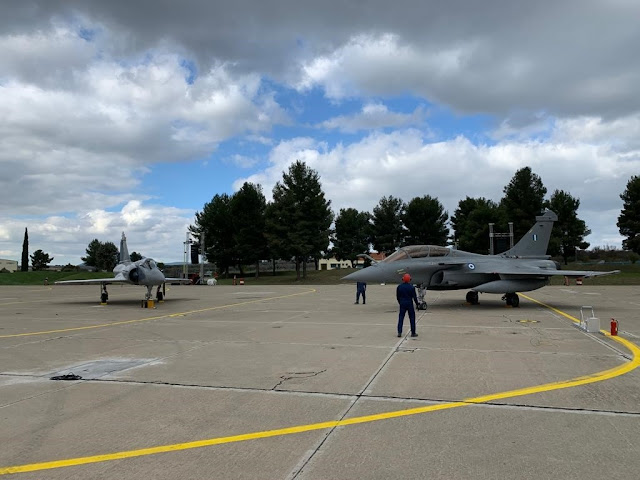
Today the first 6 Dassault Rafale F3R fighters arrived to Greece. Back in January 2021 this country bought a total of 18 together with a weapon/support package. The fleet was to combine brand new and second hand aircraft:

- New: 2 two-seat Rafale B and 4 ssingle-seat Rafale C
- Second hand: 2 two-seat Rafale B and 10 single-seat Rafale C

The contract value was approximately 1920 million €, and the weapons package 400 million €. The first 3 aircraft had already been delivered, but they remained in France to be used in training. Deliveries will last until June 2023.


30% of the payment will be carried out at the start of the contract, the other 30% 6 months later, when deliveries start. The 400 million $ weapons package will be paid in 6 years.

The fleet could grow soon, as the Greek Parliament is likely to approve the acquisition of another 6 Rafale. This contract was the first success for Dassault in Europe, and provides work for another 5 years. The French Air Force has already signed a contract to acquire the 12 aircraft sold to Greece.

References:

- https://www.reuters.com/
https://twitter.com/SafranEngines/

Monday, 17 January 2022

Operational availability of different French aircraft

The French Ministry of Defence has published these data on the operational availability of different aircraft. In the last few years there has been a sustained effort to improve these rates. A specific department in charge of maintenance has been created (Direction de la Maintenance aéronautique), and a new type of contract signed with manufacturers. It is called "verticalised" and the Original Equipment Manufacturer (OEM) is responsible to keep a certain level of availability.


Note that the NH90 is missing. This helicopter has been plagued by availability issues in the last few years, and there are no signs of major improvement.

References:

- https://twitter.com/HerveGrandjean

Friday, 3 December 2021

United Arab Emirates signs record contract for 80 Rafale fighters

French manufacturer Dassault signed today the biggest contract in its history, 80 Rafale fighters in the F4 variant with United Arab Emirates (UAE). Deliveries will take place between 2027 and 2031.

The total cost will be 16 billion €:

- 14 billion for the fighters
- 2 billion for an armament package that includes MICA NG and cruise missiles Black Saheen, a local variant of the MBDA SCALP

UAE becomes the sixth foreign operator after Egypt (54), Qatar (24), India (36), Greece (18) and Croatia (12). With this contract, the production line is guaranteed for years, and France will have more flexibility when ordering the next tranches. To put the 16 billion € into context, the cost of the Rafale program from 1989 to 2018 was 28.438 billion €, including operations and maintenance.

Rafale (Dassault).

Statement by Dasssault.


The F4 variant is currently being developed, and incorporates improvement in the AESA radar and SPECTRA system. It has also received a Scorpion helmet, better communications and new weapons.

References:

- https://www.dassault-aviation.com/en/
http://www.opex360.com/
https://www.lefigaro.fr/economie
https://www.latribune.fr/entreprises-finance

Tuesday, 27 April 2021

Interview with a former AMX30 commander of the Army of France

A former AMX30 commander of the Army of France has kindly accepted an interview for the blog. W. started his career in an AMX30 in the 80s, and is a witness of the later stages of the Cold War.

Hello W., many thanks for accepting an interview for alejandro-8.blogspot.com. Could you provide us an overview of your career in the French Army?

I began my duty in 1986 in 2eme Régiment de Cuirassiers in Reutlingen, Germany, as AMX30B2 tank commander. Transfered in 2eme Régiment de Dragons in Laon, France, as AMX30B as tank commander then platoon sergeant. Transfered in 503eme Regiment de Chars de Combat in Mourmelon for the end of experimentation of Leclerc MBT as Platoon sergeant.

Transfered in Abu Dhabi as Leclerc expert for UAE Land Forces. Coming back to 1er Regiment de Chasseurs in Verdun, France, as Platoon commander then regimental master gunner. Going back to Abu Dhabi as technical and tactical instructor for UAE Land Forces in UAE Armor School. Retired in 2015.

Deployments:

1993 and 1995 : former yougoslavia and Sarajevo as recon unit on VBL.
1999 - 2000 : kosovo on Leclerc as platoon sergeant.
2006 : Chad as platoon commander on ERC90 sagaie.
2009 - 2010 : south Lebanon as platoon commander and master gunner on Leclerc.

My 2 times in UAE are considered as deployments...

What was your impression of the AMX30 tank? What do you think were the strong and weak points?


It was my first tank in 2eme Regiment de Cuirassiers in Reutlingen when I was 20, just released from the French Armour School as a young tank commander. You just feel indestructible in it. This kind of feeling is common to all young tank commanders I bet. Then you realise that it is not true lol…

As it was an AMX30B2, the mobility was good with its semi-automatic gearbox. The preventive maintenance was easy to do and the tank was still “rustic” enough to be fixed by the crew with a string and a piece of chewing gum. The small size was also good, you are a small target in the enemy sight and it is easy to camouflage it.

The main weak points were the armour, the gun and at this time the night sights.

The armour was just too thin everywhere and you realise years later when you look at the AMX on the firing range that you served in thin metallic piece of metal….lol.

I arrived in Reutlingen in 1987 and, according to me, the 105mm Mle F1 gun was not powerful enough anymore to fight against the “new” soviet tanks with ERA (even without ERA) at a good range. Americans and Germans already used the 120mm, and even if the 105 was a good gun, the 120 was more than needful.

As a subordinate, I had a less equipped tank than the platoon sergeant and the platoon commander.

They had low light level cameras for the gunner sight and a light intensification for the CDR sight.
The 2 subordinate tanks had only the light intensification to use during the night, which means 700m maximum of observation range…Should I tell more??

AMX30 suffered quite a few reliability issues early on. Were they solved by the time you served?

As I served both AMX30B and AMX30B2, I assume you want to speak about AMX30B. As the B2 was almost the last development, this tank was reliable. For the AMX30B, and I am not really objective, this tank used a “WW2” technology…That means that the reliability of the tank reflected the involvement level of the crew in preventive maintenance. If you did not spend enough time (loooooong time…lol) to prepare your tank, you were sure to have problems as soon as you disembark from the truck or the train.

Of course some minor issues were corrected like the torsion bars to thin, the drive sprocket too fragile, all these small issues were corrected in the B2 version.

When training, at was the typical distance to the objective and speed of the tank when you fired the main gun? And the longest distance at which you ever fired?
 
It was depending of what kind of ammunition we had, real or exercise (blue). The 105 was a rifled gun. With this kind of gun you have a light deviation of the shell because of its rotation. This deviation was more important with the blue shells and we had to reduce the distance of firing.

The typical distance was around 1700m with a maximum of 2200m during the annual platoon control in Canjuers (the French tankers will remember that…)

How was the firing conducted at night? What was the effective range of the IR sight?

It was the mess!!!!! Or almost the mess (with my eyes of subordinate lol) until we have the thermal sights. Even with light intensifications, if we wanted to destroy tanks at mid or long range it was difficult.

So we trained like that: 1 tank with light intensification tried to find the targets while another tank lighted the range with his projector (the famous PH8) but no more than 10 s. If nothing was detected we changed the tank with the projector and so on until we detected something.

As soon as something was in the light the other tanks tried to destroy this target within the 10 seconds of light.

This was the way we shot at night. Of course, during the briefing the platoon commander could decide who light first, who fire first….We used the direct light of the projector because even the IR light could be detected with light intensification googles.

Everything change when thermal sights arrived on AMX30B2 (DIVT16 and DIVT18). For me it was a kind of magic that the crew was able to read a plate number at 2000m during the night. At that time there was no difference any more between day and night shooting.

The AMX30 was unique in the sense that it had a 20mm coaxial gun. Can you describe its characteristics and use? What type of ammunition was available? At what distances could you open fire?

The 20mm gun was a dream. Powerful, accurate, reliable it could replace the main gun in many different situations.

This gun was pretty big to fit in the turret but it worth it. It was designed as an anti-vehicle, anti-personal and anti-aircraft gun. The good thing with this gun is that we can choose what kind of shells we put in the belt. The typical belt was 3 armour-piercing shells and 2 explosive shells.

The average range was 1200-1300 meters in destruction mode and 1900-2000 in “suppression” mode.

This gun was a pretty hard to use and requested a high trained loader. I used it both with national service loader and professional loader. On the firing range, it was a good sigh of professionalism when your 20mm worked properly. It showed that as a tank commander, you well trained your crew and your loader in particular.

This gun was also good because of the number of ready-to-shot shells. The maximum length of the belt was almost 200 shells without reloading the gun. It was comfortable enough for the crew lol.

What were the typical distances you expected to fight in Germany? How did they compare to the ones in France?

The expected ranges were pretty short. According to the experts, in case of tank fights in Germany, the range could be between 800 to 1200m because of the woods and the density of small cities. We trained a lot to practice emergency fires and, of course to be as fast as possible because with this kind of short distances particularly, the speed is the key. The distance could have been a little more important in France, particularly in the eastern plains but not too much more, maybe around 2000-2500m.

What was the typical ammunition load (% APFSDS/HEAT)?

The load of ammunitions for the main gun depends always of the mission but typically, we used 2/3 of HEAT and 1/3 of APFSDS. On a total of 47 shells, 19 were ready to use in the turret, the others in the drum on the right of the driver.

What was the typical rate of fire and how did it vary as you used the different ammunition bins?

The rate of fire of fire was pretty good. It is not really difficult to load shells in the main gun, you just need big muscles…We were able to shot a shell every 6 seconds. The AMX30B or B2 had no stabilization, it was mandatory to be static to shot. The loader had no disturbance by the big moves of the tank during the loading time, which made his job a little be easier than if the tank was jumping on the field.

The problem of the loader is that he must be able to keep the same speed from the 1st shell to the last one, it is a real challenge for them.

Did you practice NBC situations?

We practiced more NBC training in AMX than in Leclerc. It is still a mystery to me…

Maybe because we changed the main potential enemy from “red ferocious over-powered soviet invaders” to “something we can’t defined but still enemy”. We knew that chemical use was part of the doctrine of the reds and we trained accordingly. With the end of the cold war the threat changed and maybe it was less necessary…
I guess same answer as in Leclerc

What was the maximum speed you reached in an AMX30? And going backwards?


Depends if it was with AMX30B or B2. Maximum speed was almost the same on both tanks but you reached it faster with the B2 because of its semi auto gearbox. We can easily reached 60Km/h on both of them but it was more secure with the B2 because the direction was managed by the gearbox as well, with the AMX30B the direction was given to the tank by a system of disks and brakes and it was tricky to use with high speed. I don’t remember the backward speed but it was not high…

The engine in early AMX30 variants was a multifuel Hispano-Suiza HS-110-2. Did you use this type? How easy was to switch from one fuel to the other? Was there any procedure (clean filters, purge fuel tanks)?

I only used the HS110, I never used the MACK E9. I never used anything else than diesel to fill the tanks so I can’t tell you more.
 
AMX30 used manual and semiautomatic transmissions. Did you have the opportunity to use both? How did they compare?

The AMX30 family (at least the French) used 2 types of gearbox:

Early AMX30B: Full manual gearbox
Improved AMX30B: Pneumatically assisted manual gearbox
AMX30B2: Semi auto gearbox

The gearboxes of the AMX30B were similar. The 1st generation requested a high skilled driver because it was difficult to use it in a proper way. The driver had to manage the idle and the RPM to shift the gears. If it was not the good RPM, it was not possible to engage the gear. If he was not managing the idle, he could have burnt the clutch…It was funny sometimes to observe a lot of black smoke from a tank with a bad driver.

The Pneumatic assisted one was a little bit easier to use. The pneumatic system helped the driver to engage the gear in any conditions by “pushing” the gearbox selector with a high pressure hose (I don’t know if I am clear enough   Lol). It was safer especially on open roads. But the driver still have to pay attention to the idle and RPM.

These 2 gearboxes required a lot of preventive maintenance to work properly.

The semi-automatic one was a dream to use for every driver. It was done by SESM (RENK France in another word) and was almost fully electronically managed. The driver had just to watch the idle and select the right gear to shift in. With this gear box like with the thermal sights, the AMX30B2 crews jumped in the future.

In 1991 the French Army sent a division to fight against Iraq. Do you remember if the AMX30 received some kind of upgrades/modifications?

All the AMX30B2 sent to the 1st gulf war had the same configuration:

Chassis:  Hydrostatic cooling system in replacement of the Sulzer system.
Side track protections.

Turret: Thermal sights (red)
New smoke grenade launchers (efficient against thermal sights) (green).
New Infra-Red jammer against wired guided AT missiles (blue).


How did you find the ergonomics? Did the 20mm gun in the turret affect the ergonomics?

The design started in early 60s and I don’t think that ergonomics was a big concern for the engineers but I can’t say that ergonomics were bad.

The space inside the turret was good enough to be comfortable (for a tank….lol) and the driver workstation was….like a driver workstation. The less “comfortable” was the loader as his seat looked more like a small round cushion than like a real seat.

The 20mm gun did not really affect ergonomics. As I said, we had plenty of free space to fill and when they replaced the 12.7MG by the 20mm gun, it was of course a huge improvement but did not impact the way of life in the turret.

In the 1980s GIAT designed the AMX40 to replace the AMX30. Did you have the opportunity to see it? If so, what was your opinion? Do you think it would have been a good replacement for AMX30?

Sure it would have been a good replacement for the AMX30 family but the improvement of the shells in the same time made its armour almost obsolete when the first protos were released.

I think that’s the reason why nor France nor anyone else bought it. France chose to wait for the next generation tank and many of the research for the AMX40 were used in the Leclerc program.

How confident did you feel when facing T-64/72/80? What were the recommended tactics against Soviet tanks?

We felt UNDESTRUCTIBLE!!! How do you think we must feel when NATO had 13000 tanks and the reds had 43000? If you don’t feel confident in you, your tank and your tactics you had to work for the national company of electricity lol.

But you are right, we were confident because we were sure that our technologies were better.

And we trained and trained again to be ready. More than hull down position, I think that the mobility of our brigades could have made the difference between the 2 forces.

At this time the reds had a centralized chain of command and the officers, even if I am sure that they were as good as ours, were not pushed to think by themselves and to have any kind of initiative.
The move of their divisions was frozen in the same model and was easily predictable. So, I think that I was more confident in our tactical capabilities and technologies to offset the number of their tanks.

But we were not naïve. It would have been extremely difficult for NATO forces to stop them.

In the 70/80s Soviet tanks received AT missiles to use against targets at long distances. What is your opinion on these missiles?

Refer to my previous answer regarding Germany and France, for their advance to the western part of Europe, I think these missiles were a little bit useless, especially for an offensive move. In my opinion, this kind of missiles, except the “fire and forget”, are not efficient enough for an attack: flying time too long, must be guided until the end of the flight…..

In the late 70s and 80s Israel deployed its Merkava tank, with a rather different configuration (front engine). What is your opinion on it?

The Merkava is an amazing tank. The design of this tank came from 3 principles:
- The experience from the 6-days war.
- The necessity to protect the crews mainly constituted by reservists.
- The necessity to build it locally.

The Israel engineers were realistic enough to design a tank without any new technology but only with technologies they mastered at the time of the design. The result is a tank fully designed for their needs, fully adapted to its missions.

The AMX30 was exported in good numbers to quite a few countries (UAE, Spain, Greece, Qatar, Saudi Arabia…). Do you know if the feedback from these countries was used to improve the type?

I have no information about that.

The 90s was an era when Armies transition from using to conscripts to full professional members. How did this change your unit and capabilities?


Until 1995 I worked only with conscripts even if some units were already professional in the French army. It was different but also a good time to spend with these young non-volunteer guys who had to spend 12 or 10 months in the army. These guys came from all over the different layers of the society and it was a part of the job to mix them into a homogenous batch. In the same time we had to transform them in soldiers, from basic individual instruction to crew members. It was a good challenge and most of the time we spent a great time with them, as I expect they spent a good time with us.
The main problem was that they reached the end of their time just on the time they were good and we almost never enjoy them as “specialists”.

Everything changed with the professional. They were here as volunteers, most of them (not all of them) chose to serve as tankers, we had more time to instruct them.

We spent more time for each step of the instruction because we knew that after 12 months these guys would have stayed in the army (only a few resigned after a few weeks).

So, the 1st 18 months of instruction was a kind of investment. The result was that we built solid, motivated and well instructed units. Yes the total amount of professional units was less than before but we were more efficient in all different sides of our job. And we can be deployed everywhere without complaints of the politicians (we had this kind of complaints for the deployments in former Yugoslavia: a few units were mixed 50% pros 50% conscripts). In the Leclerc I kept the same crew more than 5 years. Imagine the kind of automatisms we developed together. It was almost useless to speak on the intercom, we knew what we had to do, at the time we had to do it…This kind of thing was almost impossible with the conscripts.

We spoke about the 20mm gun. With a conscript loader, the tank commander had to keep an eye on him/it all the time. With a professional, the 20mm was his pillow, he knew it by heart…lol.

This transition was a good time to live. We had different kind of fulfilment with the conscripts that we can’t have with the professionals, the opposite is also true but I still remember all the time spent together in the tank with my conscripts…Maybe because I was as young as them…

Many say that the transition to full professional Army was necessary because of the increasing complexity of weapons. How long do you think it took to train an AMX30 crew and how does it compare to a Leclerc?

You have a part of the answer in the previous question.
I do not agree that, at least for the tanks, it is more complex now than before. The digitalization helps the crew a lot by taking in charge a few things that we had to do by ourselves.

With the conscripts, we were held by the length of their duty time so, we had to work by priorities.
With the professionals, we had all the time we need for the instructions on all a soldier must know.

I had a conscript gunner who was aeronautical engineer. Do you think it was difficult for him to master any part of the tanker job? But I lost him after 1 year. We “selected”, I don’t like this word, the conscripts according to their educational and school level and their future job in the army, and most of the time it worked great.

We did the same, at least at the beginning, with the professionals but the school level is, at 90%, less than the conscripts we had….but we have more time…..and more motivation from the professionals.

In the late 90s the French Army transition from armoured divisions to brigades. Do you think it was a good move? How did it affect training/capability?

I don’t know if it is really linked to this transition or if it is the result of the 1st gulf war but this is the time we really began to train as Teams. I mean 1 tank coy + 1 INF platoon + 1 ENG platoon + 1 ART squad + 1 TACP (not all the time).

Before, we trained in our own and, just a few times, we worked together as we were supposed to do. Around the 90s, we really started to train all together, to develop some common knowledge and culture, and for the “elders”, to discover what was the capabilities and advantages to work together.

I think also this transition brought more flexibility to the high command because it was also the time when the French army was more and more deployed and not only on its “traditional” deployments (Africa, Lebanon) but also in Cambodia, former Yugoslavia…

Friday, 5 March 2021

French Air Force carries out first operational sortie of a Rafale with Meteor missiles

The French Air Force has carried out the first operational sortie of a Rafale fighter with Meteor missiles. The combination of this weapon and the AESA radar used by the F3-R variant is a great step forward in capabilities, and one of the reasons for which Greece acquired the type.


Meteor's main advantage against other BVR missiles like R-77 and AIM-120C is its ramjet, which sustains speed for a longer period. This leads to more kinetic energy, making evasion more difficult.

According to the manufacturer, the No Escape Zone (NEZ) is 3 times higher than that of the AIM-120. Since its appearance the Meteor has become a reference in the market, and has been integrated in several  fighters (EF-2000, Gripen and Korean KF-X) - India tried to integrate it into its Flankers and Tejas fleet but did not receive authorization-.

References:


- https://twitter.com/Armee_de_lair

Appendix 1: MBDA Meteor characteristics

  (MBDA).

Sunday, 17 January 2021

Interview with a former Leclerc crew member

A few weeks ago a former Leclerc crew member accepted an interview for the blog. I would like to thank W. for his time and effort. It is worth mentioning taht W also served in AMX30, so he can explain the change from one tank to the other.

1) Hello W., thank you for accepting an interview for alejandro-8en.blogspot.com. Could you provide us with a summary of your career in the French Army?


I began my duty in 1986 in 2eme Régiment de Cuirassiers in Reutlingen, Germany, as AMX30B2 tank commander. Transfered in 2eme Régiment de Dragons in Laon, France, as AMX30B as tank commander then platoon sergeant. Transfered in 503eme Regiment de Chars de Combat in Mourmelon for the end of experimentation of Leclerc MBT as Platoon sergeant.

Transfered in Abu Dhabi as Leclerc expert for UAE Land Forces. Coming back to 1er Regiment de Chasseurs in Verdun, France, as Platoon commander then regimental master gunner. Going back to Abu Dhabi as technical and tactical instructor for UAE Land Forces in UAE Armor School. Retired in 2015.

Deployments:

1993 and 1995 : former yougoslavia and Sarajevo as recon unit on VBL.
1999 - 2000 : kosovo on Leclerc as platoon sergeant.
2006 : Chad as platoon commander on ERC90 sagaie.
2009 - 2010 : south Lebanon as platoon commander and master gunner on Leclerc.

my 2 times in UAE are considered as deployments...

2) What was your first impression of the Leclerc tank and how did it compare to the AMX 30 you had used before?

Remember that when I discovered the Leclerc, I came from AMX30B, a tank build during the 60s-70s with a 50s technology. So my 1st impression was a shock: all this 80s technology gathered in a brand new tank, just for me!!!! Lol. In the Leclerc, you do not have any revolutionary technology but this tech is made to facilitate the job of the crew: Moving faster with the pure efficient power pack, moving effectively with the inertial navigation, destroying targets at 4000m with a digital and thermal imagery, firing faster on the move with the autoloader. I said to myself: “yes, now, we are real tankers!!!”

3) What do you think are Leclerc's strong and weak points? Was there any system that could have been improved?

According to me the strongest point of this tank is the firing computer. GIAT engineers created an amazing algorithm who takes into account all the usual parameters like distance, temperatures, air pressure, altitude but also some parameters like the potential shaking on the control modules, the rotation of earth, the angle between the hull and the turret. This firing computer forgives so many mistakes to the gunner that, if you miss your target, you can blame the gunner, it can not come from the tank.

Related to this firing computer, this tank was really made to shot on the move, whatever the speed of the tank and the target and whatever the position of the turret. The firing algorithm and the stabilization are so efficient that you don t really feel any difference between a shot on the move and a static one.
For me, the last strong capability of the Leclerc is its mobility. Combined with its “small” size, that mobility makes it as a difficult target to hit on the battlefield.

Weak points?? Do you know any tank commander ready to admit any weak points on his beloved baby? Ok, I have a few. This MBT could be difficult to use. I mean if you are not the master of its technology, you cannot be good in tactics because you will spend all your time to wonder what happens in this tank (vocal alerts, vocal proposals made by the system, technical choices to be validated on the screens).

As a cold war tank, the Leclerc is a tank killer made to battle on the Ukrainian lowlands and not in cities. It is not well equipped to destroy infantry : 12.7 coax with 150 rounds ready, and external and MANUAL 7.62machine gun. That means that or the TC or the GNR (on the French Leclerc) must get out to use this MG.

The protection could have been better. But it is always a balance between protection and mobility…
After more than 20 years of duty, the XLR (Leclerc renove or Updated Leclerc in English) will improve all these weak points (Increased protection, new on-board electronic, remote external weapon).  

4) AMX 30 had a 20 mm coaxial gun, while Leclerc moved back to a more standard 12,7 mm M2 machine gun. Did you consider it to be a good decision?

You cannot imagine how the French tankers loved the 20mm. But this gun was just too big to fit in the Leclerc turret. The choice of the 12.7 is not, for me, the best one. The 12.7 is still a big MG and the space in the turret is limited. That s why we have only 150 rounds ready to fire. It s a kind of nightmare to refill the ammunition box. It could have been a better choice to have a 7.62 coax with 2500 rounds.

5) You transitioned from a 4 crew tank to a 3 crew model with autoloader. What is your opinion on this device? Did the maintenance become more intensive because you lost 1 member? This was one of the reasons why the Leclerc was rejected by the UK.

The legend of more intensive maintenance with a crew of three is false. If you are well organized, everything is fine. Of course, when you have to work on the tracks it could be tricky because 1 track is 2.2 tons. But everything is about coordination and organization. For example, in Kosovo, my crew and me had to change the tracks 3 times in 2 days and it was done. As a tank crew member, you know that the maintenance is heavy. If you don t want that you must choose another job.

6) The autoloader contains 22 rounds, another 18 are located next to the driver. How the procedure to replenish the autoloader once is is exhausted? Is this coordinated with other tanks in a platoon?

You have different ways to refill the autoloader:

• The official one says that you have to do that from inside the tank. This method was prescribed to protect the crew from shrapnel and in NRBC conditions. This method is too long.

• After different tries during experimentation, the fastest way to refill the autoloader from the drum next to the driver, is to pull the shells out by the gunner and to put them in the autoloader by its external access. It is fast, convenient and you use the autoloader software in the way it must be used to avoid non-recognized ammunitions by the system.

• You must coordinate that action under the responsibility of the platoon commander. The time you spend to refill the autoloader can’t be spent to fire on targets…Usually, the platoon commander planned these refills between 2 actions, 2 tanks by 2 tanks and the platoon sergeant planned the logistic to refill the drums.

7) When training, what is the maximum distance at which you open fire? And the maximum speed when firing on the move? What is the typical rate of fire? Was there any time you missed the human loader?

The “blue” shell is a little less efficient than the real one that is why we fire the exercise (blue) HEAT at 2300m (average). We don t have any blue APFSDS in the French army, we only fire real APFSDS, mainly in Al Hamra, Live firing range in UAE. This firing range is wide and we are able to fire APFSDS at 3800m (average). The only limitation, in term of speed and rate of fire, is the skills of the crew.

I personally fired an APFSDS at 3400m with a speed of more than 55KM/H with my most experienced crew.

This is the weirdest thing about this tank : the limitations come from the crew, not from the MBT by itself.

I never missed my human loader except for the coffee and for preparing my MRE…lol

8) Leclerc received a thermal sight. How did the night fighting capability improved with respect to AMX 30 versions that did not have it? Did you also use it during the day?

With the thermal sights, 1 for the gunner and 1 for the TC, you fight 24h a day. During the AMX30 era (except the last AMX30B2 equipped with CASTOR thermal sight), the nights were quiet as we were not really able to fire without light (provided by other tanks or artillery/mortars shells).
The thermal sights are really efficient and you fight (not only fire) during the night as you fight during the day.

It is so efficient that we use the thermal sights even during the day to detect very far targets (even humans) and in hard environments like cities. The detection range could be more than 7kms if the meteo is good, particularly in winter.

9) Did you exploit the hunter-killer capability to it's full extent? A few years ago there was some debate about the convenience of having it, as it could overwhelm the commander, who needs to focus in controlling the tank and pay attention to the BMS (Battle Management System)?

For me, hunter/killer means the TC hunts the targets while the GNR kills the target. It is exactly the way we use the Leclerc, but all the MBTs equipped with an independent 360 commander sight.

The procedure is easy : the TC aims a target with his sight then rally the turret by taking over the turret. The gunner sight is so perfectly on the target. The gunner reports on intercom that he is able to see/destroy the target. The TC release the turret control to the GNR and move his sight to find another target. And so on...

Hunter/killer and autoloader are the best friends of the tank commander…

10) Did you practice NBC scenarios? What procedures were applied?

Not often. I don t know why it is not really in cultural in the French army since the end of the cold war anymore as it was before. I am not an expert in NBC warfare.

The procedures are easy to follow. According to the level of threat, you start your NBC system (high filtered air pressure in the tank). If the level is really high, put the gas mask on.

After action, you are guided to specialized units to wash your tank with huge “karchers”. When it is done, you get outside, throw to special trash bins everything you wear and take some new BDU…
Not the best part of my training…

11) When performing exercises, what was the maximum distance you covered in a day? Were there any issues with the maintenance of the tank? What about the spare parts, any shortage?

Depends on your type of trainings and missions. You always cover more distance for offensive missions than defensive missions.

During Kosovo deployment, we were used as “light tanks” for controlling a huge area. We covered between 300 and 500kms per day without any problem. After 3 or 4 days of issues due to this heavy usage, the tanks got used of it and we did not have too much problem except the maintenance of the track pads. I was really surprised by the reliability of the Leclerc and it was a big and good surprise.

To maintain any heavy tanks, your logistic chain must be efficient. Let’s say it was not the case, and it is not still the case for the French army, even if it has improved these last years….

12) In your service you transitioned from the Cold War to local wars. Did you receive intelligence on likely opponents (T-72, AT missiles, IEDs)?

One more time, I knew 2 very different eras.

During the cold war, with my conscripts, we had a lot of lectures and instructions regarding the capabilities of the “fucking reds”. Tanks, missiles, tactics, everything must have been known according to your rank and responsibilities.

At the end of the cold war, I had the feeling, and I was not alone, that we forgot a big part of these instructions and lecture. Even the tank identification training was almost not done anymore.
 The tank commanders of my generation kept training their crews as before. Almost everybody thought we were dinosaurs..

The situation changed few years ago when the land forces chief of staff realized we had a lack of instruction.

13) Leclerc has been sold with 2 different engine types (MT883 diesel and Hyperbar diesel engine). How do they compare in different climates? What about the maintenance?

2 different generations of engines.

• MTU is 80s technology. Reliable and easy to maintain. Classic turbo charged V12 bi turbo of 27liters for 1500HP.
• Wartsila hyperbar. Full optimized diesel engine. Turbine charged V8 16liters for 1500HP.
•   
These 2 different technologies have their positive and negative sides. The maintenance is easier on MTU but the engine, according to me, is a little less efficient. The maintenance is sharp on the Hyperbar but this engine is amazing.

For hot climates, I have to admit than the MTU is perfect. The Hyperbar suffers issue, not from its technology, but by the electronic supposed to protect the powerpack…

14) Leclerc has only been exported to UAE. Other countries have chosen other options. What are your thoughts on? Do you think the Leclerc could have been modified/improved to get more success?

All is about the price.

GIAT can’t fight General dynamics and KMW in term of production. The less you produce, the highest is the cost. The Leclerc arrived also on the market while these 2 companies had a huge amount of used tanks to sell.

The problem came maybe from the company demonstrators, a team of civilians. But it is only my opinion.

15) Did you have the train with personnel from other countries? What were your impressions? Did you use/evaluate other tanks (Leopard 2, Abrams, T-90)? Was there one that you liked or disliked in particular?

I like all the tanks. I worked a lot with allies during my time in Germany and I appreciated all of them.
Americans for their infinite logistic, German for their professionalism (even with conscripts lol), British for their professionalism and phlegm.

My choice could be the Leopard 2. It seems to be a tank made by tankers for tankers. Everything in this tank is useful, solid and efficient. In 2 words : Deutsche qualitat…

My choice cannot be any Russian tanks. Of course, it is rustic and easy to use but you must be a dwarf to enter the turret…

16) When deployments in Kosovo or Lebanon took place, was there any kit installed for local conditions? Did your unit take extra spares?

On the tank by themselves, no major kit was added. We just patrolled with light vehicles equipped with IED sensors and inhibitors.

17) In 2015-2016 there were some news (L'Opinion) about Saudi Arabia buying 250 Leclerc as they had proved themselves in Yemen. Do you think it would be feasible to re-open production line?

It was almost impossible to re-open the production line in Roannes (main factory of NEXTER systems) because it was or destroy for a part, or dedicated to produce other vehicles. It could have been feasible only with a prohibitive cost…

18) In the 90s France developed more advanced versions of Leclerc, including one with a 140 mm gun. Did you have the opportunity to see it? What is your opinion? What do you think should be improved for the MLU (Mid Life Upgrade)?

The MLU is on its way in France and the first batch could be delivered at the end of this year.

Many improvements are planned: protection (add-on armor, ventral protection, anti RPG protection), networking (SCORPION program), 7.62 RWS, HMI modifications, replacement of obsolete components (mainly vetronic and electronic), new firing control calculator, multi mode 120 ammunition (delay, impact, airburst), IED jammer.

The 140mm worked well during trials. More than 200 rounds were used during these trials. It seems that the calibre increases the power by more than 60% with minor modifications on chassis and in the turret (mainly the recoil brakes). The autoloader is 20 140mm shells. I have no info about the internal drum (the 140 shells are far longer than the 120). The future of this gun is uncertain as the MGCS is still have a 120 and Rheinmetall is pushing hard for his 130mm. The 140 could be the answer to the armata T14 as the Russian are planning to put a 152mm on it.
 

Wednesday, 31 January 2018

Dassault completes the modernisation of 10 Rafale M

This month Dassault  shoudl complete the upgrade of 10 Rafale Marine F1 delivered after 1999. These aircraft were urgently handed over as the french Navy had to replace it's fleet of F-8. The cost of the upgrade to the F3 standard is 300 million euros (equivalent to 3 new aircraft). The first upgraded aircraft were delivered in 2014. The F3 version has the following capabilities:

- Use of 30mm gun and MICA IR/AM missile sin air to air missions and interceptions
- Laser guided bombs GBU-12/24 and Hammer, 30mm gun for ground targets
- Buddy refuelling
- ASMP-A nuclear missile
- Air-sea missile Exocet AM39 Block and other types
- Aréos for reconaissance

References:

- https://www.meretmarine.com/
- https://www.escadrilles.org/histoire-et-histoires/10-ans-rafale-12f/
- http://www.colsbleus.fr/articles/3100

Sunday, 12 February 2017

French weapons exports reach a record breaking €20 billion in 2016

France has broken its record for exports of weapon. 2015 had also been a record because the sales volume had reached €15 billion, but 2016 was even better due to contracts for Rafalen and submarines with India and Australia.
 
 
The graph above shows the volume of exports since 2003. There has been a huge increase since 2013 because of the Rafale and submarine sales. Main clients are India, Saudia Arabia, Egypt, Kuwait and Australia.

References:

- http://www.iiss.org/en/militarybalanceblog/
- http://www.air-cosmos.com/export-d-armes-2015-l-annee-de-tous-les-records-60713
- http://www.lopinion.fr/blog/secret-defense/record-historique-20-milliards-ventes-d-armes-francaises 

Monday, 3 October 2016

France will upgrade 55 Mirage 2000

France will upgrade 55 Mirage 2000 fighter aircraft. The decision was taken almost a year ago, but the final number had not been confirmed. With these aircraft the French Air Force (FAF) will field 225 aircraft, the current objective.

Nowadays there are 71 Mirage 2000D available. There are several reasons for the upgrade. The fighter fleet is flying much more than originally anticipated (Libia, Syria, Mali...), increasing the wear. Rafale deliveries to external clients will take priority, and none are expected before 2021.

Mirage 2000D (worldwide-military.com).

With the upgrade the FAF will have a competitive aircraft, as the more sophisticated Rafale is not walys needed. Currently there are no details on what equipment will be integrated, but it could include MICA and AASM missiles, and an ASTAC pod.

References:

- http://www.latribune.fr/pourquoi-le-mirage-2000-garde-sa-place-dans-l-armee-de-l-air
- http://www.senat.fr/rap/a13-158-8/a13-158-815.html#toc318
- http://www.latribune.fr/le-mirage-2000d-volera-dans-l-armee-de-l-air-au-dela-de-2020-531976.html
http://www.defense-aerospace.com/france-awards-contract-for-mid_life-upgrade