The Museum of Russian Military History at Padikovo has restored a T-10M that had been lying at a range. Now it looks brand new.


References:
- https://www.facebook.com/padikovo/
The Museum of Russian Military History at Padikovo has restored a T-10M that had been lying at a range. Now it looks brand new.
1. Hello J., many thanks for accepting an interview for alejandro-8.blogspot.com. Can you provide us an overview of your career in the British Army?
I joined the army in 1987 after a short stint at being an electrical engineer. Because I was quite small they recommended I join the 16/5th The Queens Royal Lancers, my local armoured reconnaissance unit. Big tanks didn’t really appeal to me at the time, it looked big and slow and not half as exciting as dashing around the woods behind enemy lines in a CVR(T)! After 6 years we amalgamated with a tank Regiment anyway, (17/21st Lancers) under the governments ‘Options For Change’ program. Those that stayed converted onto Chieftain and Challenger 1. I worked my way through the positions, driver, gunner, operator and after many operational tours around the globe, mounted and dismounted, I reached the heights of Tank Commander Challenger 2, gunnery instructor (and many other numerous qualifications on many other weapon systems). After my last tour in Al Amarah, Iraq 2004 (attached to the PWRR Battle Group), I was promoted to Sergeant Major and put out to graze as a recruiter in Nottingham. I very much enjoyed that and got an extension and left the army after 24 years service.
2. What was your impression of the Challenger 1 tank? What do you think were the strong and weak points?
The CR1 was basically a Chieftain in Challenger clothing. Inside, the turrets were almost identical with some minor differences in the sighting systems.
The external stowage was pretty good with an extra basket on the front left of the turret (for cam net and some thermal sheets) and more water Jerry can stowage at the rear.
Engine-wise it was still a pain to swap one out, but driving it was an easier automatic gearbox. I know some drivers preferred the Chieftain seat as they described it as an armchair!
3. When training, what was the typical distance to the objective and speed of the tank when you fired? And the longest distance at which you ever fired?
It depended where we were training, and where you were harboured up prior to an mission. We’d normally drive no more than a few kms to the Forming Up Point (FUP), and from there deploy in a timely fashion according to your orders. As far as speed, the tactical situation and the ground dictated how and at what speed we’d move to arrive at the FUP at the correct time.
If on an assault onto an objective, we’d generally be only 2km from the enemy before breaking ground and going as fast as the ground permitted, opening fire on anything within your predesignated arc and trying your best to keep level with the other vehicles. Generally on a large frontal assault the gunners would be given full authority to designate and to fire which freed up the Commander to busy himself with navigation, radios and counting shots and types of ammo fired.
The longest I’ve ever fired was 5kms away during an ‘indirect shoot’, which is a bit like using the tank as an artillery piece. For that you naturally have to be static but when firing on the move on a range you like the driver to get up the gears quick and keep it steady at about 30kmh. Drivers would often shout “BUMP” or “TURNING” on the intercom to warn the gunner about the road conditions. The CR1 firing system wasn’t as stable as the CR2 but in any tank, any sharp or unexpected movement of the vehicle could affect the gunners lay.
4. Challenger 1 kept a rifled gun similar to Chieftain's. Do you think it was a good idea?
A great idea! The gun was more accurate than other NATO smooth bores. Yes, we lost some muzzle velocity with Sabot and FIN ammo but this was negligible when you’re talking about speeds around 1,800 m/per sec.
5. Challenger tanks use a human autoloader and 3 piece ammunition. What was the maximum rate of fire you achieved? How did it change as you used the different ammunition bins?
The book used to say one round every eight seconds which was realistic when you consider the time it takes the gunner to do his job in aiming and firing etc. But an actual reload of the gun after it has fired is very quick. I had it down to just over three seconds if the bag charges were in a good place. But that speed couldn’t be sustained as eventually you’d have to start pulling charges from inconvenient bins. Either way it was a he’ll of a lot faster than an autoloader.
When doing long range shoots with HESH (which has a velocity of about 600m/per sec) it was every loaders challenge to get three rounds in the air at the same time, something that gave you massive bragging rights at the bar and much kudos for the crew!
Another bonus of having 3 part ammunition is the fact there are no smoking empty cases filling up the turret to get rid of.
6. British Army made extensive use of HESH ammunition. Can you comment on its characteristics and performance?
As I’ve said, it’s quite a slow round and a heavy one to be throwing around the turret. It’s a good ‘all-rounder’ for use against, bunkers, trenches lightly armoured vehicles and transport. That said, it could take out armour up to 15cm thick. It didn’t necessarily have to penetrate either, it would cause scabbing and spawling that would kill the crew inside. A hit on the weaker parts of the turret like the hatches and sights (which was quite easy due to its slow, high arcing trajectory) would be devastating, the turret interior would be shredded. As a matter of fact, in 1991, squadrons of Scimitar CVR(T) 30mm went up against tanks of the Iraqi 4th Division on Objective ‘Lead’ and defeated many T55 tanks. They either blew off the tracks and machine gunned the crew when they dismounted their crippled vehicles, or hit the sights and hatches killing the crew inside with tiny bits of shrapnel. Also the explosive blast from a vehicle being hit with 120mm hesh would collapse the lungs of anyone standing close by.
So compare that to a ‘super-velocity’ round that is pretty useless against everything else but tanks and will strike front facing stronger areas of a target, (low trajectory) has to defeat add-on, or reactive plates and then penetrate the armour. If it makes it inside and the crew have the hatches closed, the compression alone will kill the occupants before they get sprayed with molten metal. So you see, APFSDS was good but hesh was very useful.
7. What was the typical ammunition configuration load %(APFDS/HESH/Smoke)?
That depended on what tank you had. Command tanks carried an extra HF Radio so left less room in the bustle for projectiles. It was anything from 45 to 52 rounds in total if I remember rightly. You could squeeze more in if you were desperate or carrying for another callsign, two HESH bag charges in one bin and extra hesh could be stacked on the turret floor and strapped down. Too high and you ran the risk of the breech crushing them if the gun was elevated too high, so these would be used first.
Depending on your mission objectives we would take a minimum of 3 Smoke sometimes 5, all kept under the gun in the front stowage box. In 1991 more FIN an DU was issued than HESH as it was known we would face up to four times more armour than we had! So also there’s military doctrine about ratios but as a crew driving through a replen you get what you’re given!
8. What was the maximum distance you covered in a day during deployments or exercises? Did the tank cope well or needed extra maintenance?
Hard to say, in 1991 I was in reconnaissance but the battle group were manoeuvring for over 100 hours during the main battle and I never saw hardly any broken down vehicles. The trick is for all squadrons to keep their mileage down as low as possible due to the natural life of parts and the regular interval servicing that had to be carried out regardless. The desert dust was troublesome but not impossible to cope with. The CR1 would generally do around 20- 30km a day on a typical days training.
9. In terms of maintenance, was there any component or system that was more delicate? Were there any issues with the supply chain?
Banging out air filters was a popular past time! The night vision system seemed to be different on all vehicles, with a well pressured system and a fresh compressor oil change the picture could be great, but if overdue a service it would be rather useless. I never suffered issues with the supply chain. Some larger items were logistically more difficult to ship up to the front, or find you in the middle of the forest (like engines and tracks) but it was down to the efficiency and planning of the echelon forces which could vary from Regiment to Regiment.
10. Challenger received a hydropneumatic suspension while other tanks of its era used torsion bars. What is your opinion on its advantages and disadvantages? Hydrogas suspension was a nice ride, very reliable and a damned sight easier to change than torsion bars!
The only downside was that if it was cold the tank would sit low or sag to the front/ rear or one side and it took a little cross-country driving to warm it up. Quite funny trying to climb aboard a tank that was sitting high, it required leg flexibility, arm strength and a manly groan!
11. One of the big improvements over the Chieftain was the 1,200HP Perkins Condor CV12 engine. When driving/moving can you feel the difference between a 2 stroke and 4 stroke engine?
Didn’t notice the speed difference but take off was smoother and quicker on the CR1. Clutch springs used to fail on the Chieftain, possibly the worst job to replace...after boost filters. The chieftain track was also ‘dead’ so easier to change but a heavy weight for the drive sprockets to get moving. CR1 had a ‘live’ track so a little more work in replacing it but more reactive when driving so a bit more reactive and faster. We all miss the distinctive tubular roar of the Chieftain though!
12. What was the maximum speed you managed to get in a Challenger? And in reverse?
60kph in a CR1, 70kph in a CR2. I Only reversed a CR1 at speed on a firing range to return to the firing point whilst keeping the gun pointing in a safe direction. You went as fast as you dared depending on how competent the driver was and how good your intercom was with the driver. If all good, it was not problem to ‘belt it’ full speed, but if the driver had problems with his ‘left and right’, it would be wise to take it easy if you’re shouting at him which sticks to pull! I had a driver who managed to hit 17 trees in 2 weeks!
13. Did you practise NBC situations? What was the approach?
Yes, a lot!
Put your mask on, clip an NBC radio Mike to the mask and plug it into a dedicated socket on your helmet earphone, then connect the hose from your NBC diffuser to the mask. The NBC system was a heavy load facility and needed a lot of power. Something to consider as it would be wise to turn on the Generator Unit Engine (GUE) to make sure your Computerised Sighting System (CSS) didn’t trip out. The pressure inside the turret would be kept at about 3bar. This stopped any gasses creeping into the turret through minor cracks/ gaps around periscopes and gun mantlet seals.

Once, whilst on exercise as an operator/ loader, my Commander didn’t bother putting his respirator mask on and just plugged the NBC mike into his earphone and left it dangling. If he had to talk on the radio he just he just grabbed the Mike and cupped it next to his mouth. Pretty convincing if you heard it!
In 1991 they estimated we could loose up to 70% of the Recce forces in the initial chemical bombardments, but it never played out like that in the end and I always felt as safe as houses in a mask and suit, closed down breathing through new filters.
14. Did you have the opportunity to train with other countries (NATO for example)? What was your impression about their training and equipment? Any tank (or other weapon) you liked or disliked?
I trained Iraqi troops and police but only with Russian type small arms etc. We war gamed with the Polish cavalry in Poland once. They were quiet and sneaky in those T72s which were as low as pancakes and hard to spot! I had the opportunity to cross paths with a German Leopard 1 once. It had an incredibly loud engine, rather cramped inside and the gunner told me that occasionally they lost coincidence between the thermal camera and the gun. If the gun went to maximum elevation, the thermal camera wouldn’t follow and just drop and stare at the dirt. We had the same problem on CR1. We called it “TISH Crash”. (Thermal Imaging Sensor Head). It required a quick routine of levelling the gun and operating a flurry of switches and buttons to correct the issue on the Symbology Processing Unit (SPU, affectionately pronounced “Spew”...as in vomit).
We were all jealous of the Leopards manoeuvrability and the fact they could change an engine in twenty minutes!
A task that normally took four hours for us. I always said the best tank in the world would be a CR2 top half and a Leopard bottom half! The deadliest nato pantomime pony.
As for the American M1 Abrams, we used to go down to Grafenwöhr a lot to use their Simnet simulator facility. We often had the chance to visit their range to see them live firing. Never have I seen so many tanks break down in one day! They always boasted about their bigger engines but they were dragging tons of heavy armour so they needed it to keep up with the men on foot!
How confident did you feel when facing T-64/72/80 during the Cold War? (If you served during the Cold War)
I was on CVR(T) during the Cold War and our life expectancy after reporting the positions of the Russian main vanguard force was twenty minutes.
15. Challenger 1 performed well in the Gulf War of 1991. Did you receive any information regarding its use and improvements that could be applied?
Apart from new dust filters and skirts to keep the dust down, they looked the same. The main bonus was the Chobam/ Dorchester armour that didn’t exist on Chieftain.
16. Do you think there was room for improving the Challenger 1 or it was better to move into Challenger 2?
As I’ve mentioned, the CR1 was pretty much an up-armoured Chieftain. Comparing the CR1 to the CR2 is like chalk and cheese. Like stepping out of a Ford Escort and into the Starship Enterprise. Completely new ergonomically, new ‘playstationesque’ controllers, new CSS with a Sagem gunners sight. An entirely new digital software package.
17. Is there any anecdote you would like to share before concluding the interview?
Yes, in 1989 a German Panzer captain came to our Regiment to give a presentation on the Leopard tank. He stood firmly at the lecturn with a really cold sturn face, sharply removed his cap in a brisk parade drill move and slowly surveyed the auditorium with a sneer of authority....“Good mornink gentle-mens, I am Captain Steiner from ze 13th Panzer grenadier Battalion....as you can tell, I am German, so throughout ziss presentation...zer vill be NO...jokes”
We all sank in our chairs thinking ‘wow, it’s true about the Germans!’
The captain then bent down slightly to press ‘play’ on a video recorder. We were then subjected to the most action packed jaw dropping video of a Leopard doing impossible feats of speed, spinning, jumping through hoops of fire, hull spinning one way, turret spinning the other, guns blazing, targets exploding as it effortlessly engaged in car crushing mayhem to sound of a German military band......
Needless to say, we all knew our Chieftain’s would mostly crawl out of the gate, dead tracks clanking, dumping oil on the road as the clutch springs struggled and engines giving up 20 yards down the road. I guess he knew that too, because the video finished, he pressed the ‘stop’ button, stood up straight and with a massive grin on his face, his head head went slowly from left to right with three words....
“Ha...Ha...Ha!”
He was the first German to make me laugh!
Other interviews:
I am always looking for more
veterans, active members or people related with the defence industry to
accept interviews. If you enjoyed reading the material and would be
happy to accept an anonimous interview you can get in contact with me.
My e-mail can be found in this link at the heading. Otherwise leave a
message in the comment sections.
- Interview with a former M551 Sheridan driver
- Interview with a former Centurion tank driver in the Army of Sweden
- Interview with a former Centurion tanker in the Army of Denmark
- Interview with a USAF pilot who flew the F-106 Delta Dart
- Interview with an US Army M48A5/M60A1 veteran tanker
- Interview with a former British artilleryman and veteran of the Gulf War
- Former M60 tanker in the Army of Austria
- Former Chieftain crew member
- Former Chieftain gunner
- AMX30 commander of the Army of France
- NCO of the Army of Serbia
- Former crew member of Challenger 2
- Former Leclerc commander
- T-72 driver in Czech Army
- US Army M60 tank crewmman
- Interview with D., former US Army tanker with experience in the M60 and M1 Abrams
- Interview with Stefan Kotsch, former NVA/Bundeswehr tanker
- Interview with former Marine and writer Kenneth Estes
Dassault CEO Eric Trappier and Indonesian Air Force (TNI-AU) Vice Marshal Yusuf Jauhari have agreed on the acquisition of 42 Rafale fighters for the TNI-AU. A batch of 6 will be delivered first, followed by 36 others.
At the moment there are no details on the variant or calendar for deliveries. It has been pointed out that Indonesia has never operated a French fighter before, thus it is a significan win for the French manufacturer. The total amount of Rafale sold abroad is now 278.
It is likely that Inonesia's first batch is financed with the funding that was saved for the Su-35. TNI-AU had originally selected this model, but the risk of CAATSA sanctions prevented the signing of the contract.
References:
- https://twitter.com/florence_parly
 |
| Press release (dsca.mil) |
6-2-2022
Leaked video of the accident. The F-35 tries to land at high speed and the landing gear collapses. The pilot then losses control over the deck.
27-1-2022
First photo of the Lighting after the incident.

 |
| Press release |
 |
| F-35C Lightning II belonging to VFA-147 "Argonauts" on USS Carl Vinson. |
References:
- https://www.cpf.navy.mil
- https://news.usni.org/
A few weeks a former Sheridan driver kindly accepted an invitation for an interview. K. served in the 73rd Armour Regiment as a M551 Sheridan driver and deployed to Saudi Arabia prior to participating in the Gulf War.
1) 1. Hello K., thanks for accepting an interview for alejandro-8en.blogspot.com. Could you provide a brief overview of your experience with the M551 Sheridan tank in the US Army?
I joined the Army in November of 1988. Since I optioned for Airborne, directly after completing 15 weeks of Cav Scout training, I went directly to Ft. Benning for 4 weeks of Airborne training. I arrived at Ft. Bragg in April of 1989 and was assigned to Aco. 2nd Platoon, 3/73rd Armour. I service with the M551A1 from 1989 to 1992. I started as a driver and drove for two different crews before going to the Gulf with my third crew. I continued to work in the driver position throughout Desert Shield and Desert Storm. When we returned from the Gulf War, I served with my last crew as a loader.
Our role with the 82nd Airborne Division was Heavy Recon and Armor support for each task force. We would conduct Route, Area and Zone Reconnaissance both mounted and dismounted. We would also conduct traditional armored tank tactics in support of the task force.
2. What do you think were the strong and weak points of the Sheridan tank?
#2 Strong points.
Our small size enabled us to be highly maneuverable, especially in a wooded environment. We could slot between trees that would leave a larger track vehicle trapped. We could fire and move in a tight wooded environment at will. Our gun barrel did not overhang the front deck so we could hide in ambush, fire at a target then pivot and move out of the area quickly.
The Sheridan's weight was 17 tons so we were fast on tarmac and in a field environment.
During Desert Operations, the Sheridan had the lowest ground pressure level of any vehicle in theater, wheeled or tracked, allied or enemy. The MTLB was the next best. We would simply float over soft wet sand that would trap any other vehicles.
If needed, we could also erect the water barrier and ford a body of water, just float along to the other side and continue operations. It did take some prep time for amphibious operations, but definitely a unique capability if needed.
We were air mobile. One Sheridan would fit inside of a C130 transport aircraft. It was an Extremely Tight fit. Imagine having to drive into a C130 with only inches of clearance on each side. We would totally wreck the plane if we got it wrong. The Sheridan could be strapped to a pallet and extracted from a C130 onto a landing strip via a drag parachute or air dropped from altitude using 8 G11 parachutes. This procedure was used during operations in Panama which resulted in two failures.
#2 strong points continued
We had a variety of ammunition to use. HEAT ( high-explosive anti-tank ), flechette (Bee Hive) and the missile. While HEAT ammunition might not be as effective as modern kinetic energy ammunition, it will still render a kill on many types of armor or light skinned vehicles. The Bee Hive ammunition would decimate soft targets. The missile had a long standoff range, but we had to stay stationary and keep the motor above 1,500 revs during its whole flight to target or suffer loss of control.
The Reliability of my track in theater was outstanding. I Never suffered a breakdown or system Failure during operations in Desert Shield or Desert Storm.
#2 weak points
Being essentially a light tank that is only 17 tons, the Sheridan can survive up to 12.7 mm fire without issue. Surviving cannon fire of 20mm or greater is worrisome. Our hull is aluminum with foam core behind the outside deck skin where the water barrier is stored. From the first to third roadwheel is all ammunition in the hull. The driver has missiles on the right, HEAT rounds on the left and two Bee Hive rounds under the driver seat. The Sheridan was not designed for head to head, tank on tank battle with medium or MBT'S. Ambush or shoot and move tactics are best. Same as US tank Destroyer units during WW2.
The crew must be mindful of moisture getting into electrical connectors, Dielectric grease is a must to combat corrosion.
The heavy recoil from the main gun can disable the missile control on occasion, but my crew never experienced this during tank gunnery.
Throttle body issues can spring up at times. This will reduce power, but not disable the motor. I experienced this during training at Ft. Bragg, but not in the Gulf theater of operations.
A small size also leads to extremely cramped working conditions for larger crew members.
3. The Sheridan was unique in the sense that it combined HEAT rounds with AT missiles. What was the typical ammunition configuration (% of HEAT and AT missiles?
This photo shows a combat load. This photo was taken at Champion Main in Saudi Arabia during Desert Shield. We were also issued New M551A1 tracks with thermal sights before moving to forward positions on the border of Iraq and Saudi Arabia.
4. When training or in combat, What was the typical distance to the objective? And the longest distance at which you ever fired a missile or round?
Maximum effective range for a HEAT round is 1,200 meters. Missile engagement can go out to 2,000 meters.
A M551A1 fired a missile at a connex target during gunnery training in Saudi Arabia. The official range to target was 3,000 meters. The connex was completely destroyed. In the right conditions, the missile was a very deadly standoff weapon.

5. Was the Sheridan capable of firing in the move? At what speeds if thsi is the case?
During gunnery training, we qualify with at least two on the move engagements. This is difficult for the driver to travel at a slow speed. The tracks create a vibration frequency that causes the gunners target sight to bounce severely. It is up to the driver to regulate his speed in order for the gunner to engage the target. We drive about 2 to 5mph estimated. It's all about the smoothest speed.
6. What about firing in the night? How was it performed (battlefield illumination) What was the maximum distance at which you could fire?
We have to engage several targets at night during gunnery training. The maximum effect range is reduced slightly and no lighting is used to illuminate the target. Before Desert Storm, we only had optical sights to perform this task. Thermal sights were a god send.
7. What was you impression of the thermal sight installed in the TTS version (if you ever used it)?
When all of the Sheridan crews were issued brand new M551A1 tracks, they were equipped with thermal gun sights. The cooling system for the sight was noisy, but the sight was so effective , we didn't mind unless you were trying to sleep. When given the choice between White Hot or Black Hot, I always prefer White Hot. I detect better contrast and target details using White Hot. Even though I am not a gunner, I still had to do my observation duty using the thermal optics.
8. In terms of maintenance, was there any component or system that was more delicate? Were there any issues with the supply chain?
At Ft. Bragg, the various Sheridan's had their own Gremlins. Electrical faults primary because of old or broken connectors, motor throttle body, injectors, hydraulic leaks, slow gun breach motors and gas particulate system issues. These M551A1 units were all in a state of heavy use. If something broke, we simply repaired the fault and kept on training.
During the Desert Shield phase of operations, all crews were issued brand new Sheridan's equipped with new thermal gun sights. We transferred our radios and combat load to the new units and continued with the mission.
My personal, new track, never suffered any mechanical faults period. In 120 degree Fahrenheit, the Sheridan would heat soak. I had to drive in open desert with my hatch closed, without any air circulation system. Inside temperature was well above the outside temperature during operations. As a driver, I performed maintenance checks on the motor pack every time we stopped for a break. The Detroit Diesel engine and transmission were utterly reliable throughout combat operations.
9. What was the maximum distance you covered in a day during deployments or exercises? Did the tank cope well or needed extra maintenance?
I never calculated distance, only hours traveled. I just drove until told to stop. During Desert Storm, we were loaded on HET transportation trucks and transported deep into Iraq on a 3 day transport mission. When the trucks off loaded us, it was 3pm on the third day. I performed a maintenance check on the pack and we set off into the unknown. We traveled Non Stop from 3:30pm that day until 3am, 12 hours straight without any breaks. After a 3 hour stop, we moved out at 6am toward our first Royal Guard Force objective. The Sheridan Never missed a beat during that 12 hour drive.
Our Mission was Search and Destroy, following behind the 24th ID Tank forces.
10. Being an airborne tank, could you describe a typical scenario that called for the deployment of the M551? What were the tactics used (Quick deployment in rear of the enemy for example)?
During traditional combat operations, the 82nd Airborne is used as a Shock Force. One of our missions is to attack an enemy air base and take over control for Allied use. Sheridan's performed this mission as part of an 82nd Airborne Task Force during Desert Storm. My Aco. 1st, 2nd and 3rd platoons were tasked to support other 82nd Task Force elements to take Tallil Air Base in Iraq. We removed over 250 Iraqi troops from the base and proceeded to systematically search and destroy any weapons and aircraft. We also performed recon for any hidden personnel. I was part of 2nd platoon.
11. Did you trained with personnel from other countries? Did you use any of their equipment? What were your impressions (training and equipment)?
The 82nd Airborne operated alongside of the French Foreign Legion and British expeditionary forces during Desert Storm. I personally met legionnaires and was impressed by their professional nature.
12. Were you able to get familiarised with Soviet tanks. What was your impression? Was there any Soviet system you liked or disliked?
I was born in 1968 so I grew up during the Cold War. As a child, I researched all Soviet military vehicles and weaponry. I could identify every T series tank, infantry fighting vehicle, tank destroyer and armored wheeled vehicle that Russia had to offer. These tanks had a reputation for being rugged and effective in the many battles that they were used in. During Desert Storm, I only saw them as destroyed relics, littering the battlefield. I'm sure that if our Sheridan had to engage one in battle, the first to strike and hit it's target would have been the victor. We could equally destroy each other, but they were no match for the M1A1 MBT and a modern sabot kinetic round.
 |
| This is a photo of my personal track, A22. She was named after the loaders sweetheart, Amy. I drove all over Saudi Arabia and Iraq in this M551A1 Sheridan. The men in in the photo along with me are my combat brothers from Aco. 2nd Platoon. 3/73 Armor, 82nd Airborne Division. |
13. M551 was retired in the mid 1990s. Do you think it was a good decision or that it could have stayed in service with more improvements?
The US light tank programs started with the M3 Stuart and ended with the M551A1 Sheridan. The Sheridan had a very long service life. It was both an honor to serve as a crew member and a childhood dream come true. The US light tanks traditional battlefield role has always been primarily armored reconnaissance. On the modern battlefield, LAV and Striker wheeled platforms have taken over this role along with IFV duties. There will probably never be another armored tracked fighting vehicle similar to the Sheridan's capabilities, it would simply cost too much to develop.
14. Is there an anecdote you would like to share before finishing the interview?
Be careful of what you wish for or dream about as a child.
As a child, I studied WW2 battles and vehicles, my favorite being the North African Campaign. Montgomery's forces going head to head with the Desert Fox and the exploits of the famed SAS Desert Rats. One day, I learned about the M551 Sheridan and it became my obsession. At the age of 20 in 1988, I joined the Army knowing that the 82nd Airborne Division actively used the Sheridan. I also wanted to be a reconnaissance soldier which is also the only way to become a Sheridan crew member. How many birds can I hit with one stone, I thought to myself. After 15 weeks of OSUT Cav Scout training and 4 weeks of Airborne School, I finally got to meet the Sheridan in person. I was in absolute heaven and set out to be the best driver possible. I had a natural feel with the Sheridan and excelled in my role. We trained to fight the Russian forces primarily in a wooded environment, never knowing about the change of plans coming around the corner.
 |
| M551 Sheridan opening fire. |
At 21 years old I found myself driving off of a C5 Galaxy into a desert environment. My group of Sheridan's were the second phase arriving in Saudi Arabia. We knew that the Iraqi tanks were on the border, poised to invade Saudi Arabia. We set up a battle plan and waited for a fight. My platoon ended up 330km from Baghdad as part of a Task Force to take Tallil airbase. We accomplished our mission and headed back to Champion Main in Saudi Arabia. At the age of 22, I got to experience the same fighting conditions as the troops from the North African Campaign, driving around the desert, buttoned up in a tracked vehicle.
Other interviews:
I am always looking for more
veterans, active members or people related with the defence industry to
accept interviews. If you enjoyed reading the material and would be
happy to accept an anonimous interview you can get in contact with me.
My e-mail can be found in this link at the heading. Otherwise leave a
message in the comment sections.
- Interview with a former Centurion tank driver in the Army of Sweden
- Interview with a former Centurion tanker in the Army of Denmark
- Interview with a USAF pilot who flew the F-106 Delta Dart
- Interview with an US Army M48A5/M60A1 veteran tanker
- Interview with a former British artilleryman and veteran of the Gulf War
- Former M60 tanker in the Army of Austria
- Former Chieftain crew member
- Former Chieftain gunner
- AMX30 commander of the Army of France
- NCO of the Army of Serbia
- Former crew member of Challenger 2
- Former Leclerc commander
- T-72 driver in Czech Army
- US Army M60 tank crewmman
- Interview with D., former US Army tanker with experience in the M60 and M1 Abrams
- Interview with Stefan Kotsch, former NVA/Bundeswehr tanker
- Interview with former Marine and writer Kenneth Estes
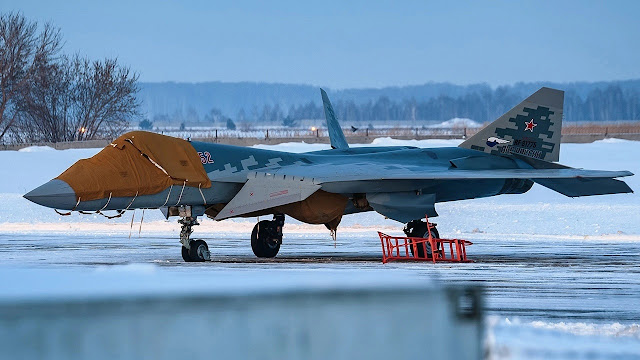
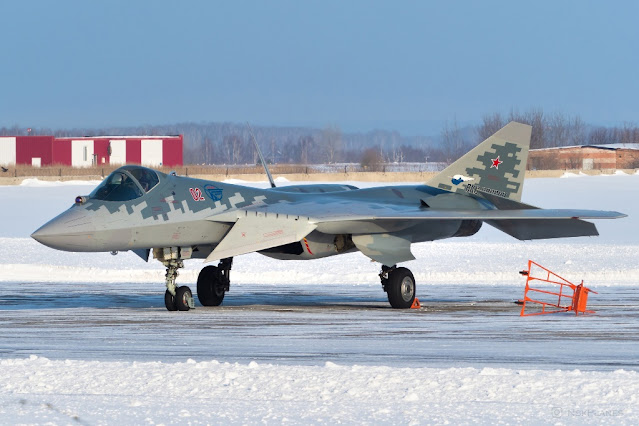
Nice photos of Su-57s at Novosibirsk. These are the fighters nominally supplied to the Russian Aerospace Forces (VKS) in 2021. In one of the photos the IRST sensor can be seen.